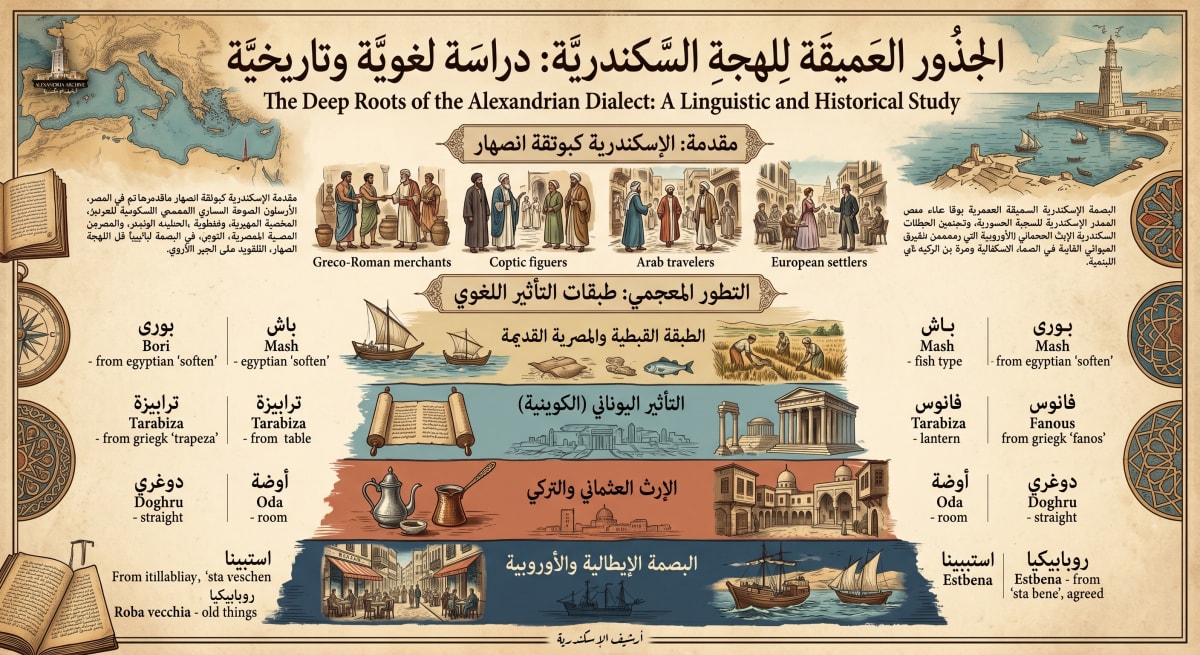
مقدمة: الإسكندرية كبوتقة انصهار لغوي وثقافي عبر العصور
تمثل الإسكندرية، منذ تأسيسها في عام 331 قبل الميلاد على يد الإسكندر الأكبر، ظاهرة لغوية وحضارية فريدة في حوض البحر الأبيض المتوسط. لم تكن المدينة يوماً مجرد امتداد جغرافي لدولة ما، بل شكلت بؤرة مركزية تتقاطع فيها خطوط التجارة العالمية والهجرات البشرية المستمرة، مما أنتج بيئة حضرية متعددة الأعراق واللغات بامتياز. إن دراسة اللهجة السكندرية المعاصرة، والتنقيب عن أقدم الكلمات المستخدمة فيها، لا يُعدان مجرد عملية حصر معجمي للمفردات، بل هما أشبه بتنقيب أثري دقيق في طبقات التاريخ اللغوي والاجتماعي. تكشف كل كلمة في هذه اللهجة عن حقبة زمنية محددة، أو جالية استوطنت المدينة وأثرت في نسيجها، أو نشاط اقتصادي ساد في أروقتها وموانئها.
تأسست اللهجة السكندرية عبر آلية التراكم اللغوي والاتصال اللغوي الكثيف (Language Contact)، حيث تفاعلت لغات المستوطنين والوافدين مع لغة السكان الأصليين بشكل ديناميكي لم ينقطع على مدار أكثر من ألفي عام. في البدايات الكلاسيكية للمدينة، سادت اللغة اليونانية القديمة بمرحلتها المعروفة بـ "الكوينية" (Koine Greek) كلغة عليا للإدارة والثقافة والتعليم، بينما استمرت اللغة المصرية القديمة، بتطوراتها الديموطيقية ثم القبطية، كلغة محكية للحياة اليومية بين السكان الأصليين في المدينة والمناطق المحيطة بها. ومع الفتح الإسلامي لمصر، دخلت اللغة العربية لتشكل الغطاء اللغوي الأكبر وتفرض سيادتها (Superstratum)، لكنها لم تمحُ اللغات التي سبقتها بجرة قلم، بل هضمت واستوعبت الكثير من المفردات القبطية واليونانية التي كانت قد تجذرت في الحياة اليومية.
تطورت هذه البنية التحتية اللغوية لاحقاً عبر موجات متتالية من التأثيرات الديموغرافية والسياسية التي فرضتها التحولات الاستراتيجية في المنطقة. فقد ترك الوجود العثماني، الذي امتد لقرون، بصمة واضحة وقوية في المصطلحات الإدارية والعسكرية والحياتية، وحتى في أسماء الأطعمة. وفي القرنين التاسع عشر والعشرين، ونتيجة لسياسات الانفتاح والتحديث التي شهدتها مصر، توافدت على الإسكندرية جاليات ضخمة من الإيطاليين، واليونانيين، والفرنسيين، والأرمن، واليهود السفارديم الذين حملوا معهم لغاتهم المتباينة، بما في ذلك لغة اللادينو (الإسبانية اليهودية) التي تعود جذورها إلى الأندلس.
أدى هذا التمازج الديموغرافي والاقتصادي إلى تشكيل لغة تخاطب يومية مشتركة (Lingua Franca) خاصة بالمدينة، اقتبست من كل جالية كلمات تتعلق بتخصصها المهني أو نمط حياتها. اندمجت هذه الكلمات تدريجياً في البنية الصرفية والصوتية للغة العربية، لتنتج اللهجة السكندرية التي نعرفها اليوم، والتي تتميز بمرونتها الفائقة في تطويع المفردات الأجنبية. تستهدف هذه الدراسة تفكيك البنية المعجمية للهجة السكندرية، وتتبع الأصول الدقيقة لأقدم الكلمات المستخدمة فيها، مع تحليل التطورات الدلالية والصوتية التي طرأت عليها عبر الزمن، وصولاً إلى فهم شامل لكيفية تحول هذه اللهجة إلى محدد أساسي للهوية الثقافية لسكان الإسكندرية.
الإطار النظري: تداخل اللغات وتشكيل الهوية الصوتية للعروس المتوسطية
لفهم التركيبة المعقدة للهجة السكندرية، يجب وضعها في سياق النظريات اللغوية الحديثة المتعلقة بتداخل اللغات (Language Contact) والتغير اللغوي (Language Change). تعتمد هذه الدراسة على تحليل مفردات اللهجة وفقاً لثلاث طبقات لغوية أساسية: الطبقة التحتية (Substratum) والتي تمثلها هنا اللغة المصرية القديمة والقبطية، والطبقة الفوقية (Superstratum) التي تمثلها اللغتان العربية والتركية العثمانية، والطبقات المجاورة أو الوافدة (Adstratum) والتي تمثلها اللغات اليونانية، والإيطالية، والفرنسية، ولغة اللادينو.
عندما توافد المهاجرون الأوروبيون على الإسكندرية، لم تكن هناك عملية إحلال لغوي كامل، بل حدثت استعارة معجمية مكثفة (Lexical Borrowing). تُعرّف الاستعارة المعجمية بأنها دمج ميزات أجنبية في اللغة الأصلية لمجموعة ما بواسطة متحدثي تلك اللغة، حيث يتم الحفاظ على اللغة الأصلية (العربية في هذه الحالة) مع إثرائها بإضافة الميزات المدمجة. وقد أشار علماء اللغويات إلى أن المتحدثين الذين يتواصلون بلغة أصلية ويملكون معرفة بلغة أخرى يميلون إلى استعارة المفردات إما لسد فجوات معجمية لأسماء أدوات ومفاهيم حديثة (Cultural Borrowing)، أو لتفضيل استخدام كلمات أجنبية تحمل دلالات اجتماعية معينة تعكس التمدن أو الانتماء المهني (Core Borrowing).
وقد شهدت الإسكندرية حالة من الازدواجية اللغوية (Diglossia) في العصور القديمة بين اليونانية والقبطية ، وتكررت هذه الظاهرة في العصر الحديث حيث تعايشت العامية المصرية مع اللغات الأوروبية. ومن الظواهر المثيرة للانتباه في اللهجة السكندرية هي قدرتها الاستثنائية على تكييف الكلمات الدخيلة صوتياً وصرفياً (Phonological and Morphological Adaptation). فالكلمات الإيطالية واليونانية لم تبقَ كأجسام غريبة في الجملة السكندرية، بل خضعت لقواعد الجمع المكسر، واقترنت بأدوات التعريف العربية، بل واشتُقت منها أفعال ومصادر وفقاً للأوزان الصرفية العربية، مما أذابها تماماً في اللسان المحلي.
الطبقة التحتية: الأصول المصرية القديمة والقبطية (تأثير اللهجة البحيرية)
تُعد اللغة المصرية القديمة في طورها الأخير، والمتمثل في اللغة القبطية، الركيزة الأساسية والطبقة التحتية التي بُنيت عليها اللهجة العامية في مصر بشكل عام، والإسكندرية بشكل خاص. انقسمت اللغة القبطية تاريخياً إلى عدة لهجات جغرافية تباينت في أصواتها ومفرداتها، كان أهمها في الوجه البحري والإسكندرية "اللهجة البحيرية" (Bohairic Dialect). ازدهرت هذه اللهجة كلغة أدبية من القرن الثاني وحتى القرن الثالث عشر الميلادي، وأصبحت لاحقاً لغة الطقوس الرسمية للكنيسة القبطية الأرثوذكسية في الإسكندرية. استمر التحدث باللغة القبطية حتى عصور متأخرة تقترب من القرن السابع عشر قبل أن تتراجع كلغة تخاطب يومي لصالح اللغة العربية، لكنها تركت إرثاً معجمياً ضخماً لا يزال حياً ومتداولاً على ألسنة السكندريين حتى اليوم.
يتضح تأثير اللغة المصرية القديمة والقبطية بشكل جلي في المفردات المرتبطة بالزراعة، والظواهر الطبيعية، والأدوات الأساسية، والأهم من ذلك في الكلمات التي تُستخدم لمخاطبة الأطفال (Baby talk). تشير التحليلات اللغوية إلى أن الكلمات ذات الأصل الفرعوني والقبطي قد قاومت الاندثار بشراسة، ورغم خضوعها لعمليات تكييف صوتي طفيفة لتناسب النطق العربي، إلا أنها احتفظت بدلالاتها الأصلية بدقة متناهية.
من أقدم الكلمات ذات الأصل الهيروغليفي التي لا تزال تُستخدم في الإسكندرية ومحيطها الجغرافي كلمة "باش" (Bash)، والتي تُقال عادة في سياق تبلل الأشياء بالماء حتى تفقد صلابتها، مثل القول الدارج "العيش باش"، وهي مشتقة من جذر فرعوني أصيل يحمل نفس المعنى المتعلق بالليونة والتحلل بالماء. وبالمثل، تُستخدم بكثرة كلمة "كوش" (Kosh)، كأن يُقال في العامية السكندرية "كوش على كل حاجة"، ولها أصل فرعوني قديم يعني التجريد المطلق أو أن يترك الشخص بلا شيء أو عارياً، وقد تطورت دلالتها عبر الزمن في العامية لتعني الاستحواذ المطلق والطمع الذي يترك الآخرين بلا شيء.
أما فيما يخص الظواهر الطبيعية والطقس، فتُستخدم كلمة "صهد" (Sahd) للتعبير عن الحرارة الشديدة المنبعثة من الأسطح أو الأجواء، وهي كلمة فرعونية الأصل تعني بشكل مباشر اللهيب أو الحرارة المرتفعة. كما تُطلق لفظة "شراقي" (Sharaqi) على الأراضي الجافة أو الزراعات التي لم تصلها مياه الري في وقتها، وهو مصطلح زراعي متجذر في القاموس المصري القديم لارتباطه بدورات فيضان النيل. وفي سياق الحث على العمل والسرعة أثناء أداء المهام البدنية، يتردد نداء "هوب هوب" (Hop Hop)، والذي يعود أصله إلى الكلمة الفرعونية "أويبة" وتعني الشغل أو استعجال الحال. ومن المثير للاهتمام بشكل خاص أن كلمة "جاي" (Gai)، التي تعني المجيء في اللغة العربية الفصحى، تتداخل في الاستخدام مع الكلمة القبطية المأخوذة من الهيروغليفية "أوجا" (Oja)، والتي كانت تعني السلامة أو الخلاص أو العافية، وتُستخدم أحياناً في التراث المحلي كرد على التحية بنفس المعنى العميق.
على صعيد النشاط البحري والصيد، وهو النشاط الاقتصادي الأبرز تاريخياً في مدينة ساحلية كالإسكندرية، نجد أن الصيادين لا يزالون يستخدمون مفردات يومية تعود جذورها لآلاف السنين. من أبرز هذه المفردات اسم سمكة "بوري" (Bori)، وهو اللفظ المصري القديم الذي كان يُطلق على الأسماك بشكل عام في النصوص القديمة، وتخصصت دلالته لاحقاً (Semantic Narrowing) ليُطلق حصراً على هذا النوع الشهير من السمك. كما يستخدم الصيادون وعمال بناء المراكب كلمة "وجلة" (Wajla) للإشارة إلى آلة حادة مصنوعة من الحديد، وأصلها يعود للكلمة القبطية الصريحة (ⲁⲩϫⲁⲗ - aogal).
يمتد التأثير القبطي والمصري القديم إلى أعمق زوايا الحياة الأسرية، وتحديداً في الكلمات التي تُلقن للأطفال في سنواتهم الأولى لسهولة نطقها. كلمات مثل "تاتا" (Tata)، التي تُقال للطفل الرضيع لتشجيعه على المشي، تعود أصولها إلى الكلمة المصرية القديمة التي تعني التدرج أو "ببطء" أو "خطوة بخطوة". وكلمة "إمبو" (Emboo)، التي تُستخدم للتعبير عن رغبة الطفل في الشرب، هي اختصار تركيبي للعبارة المصرية القديمة (eb-moo)، حيث تعني "eb" (أريد) و"moo" (ماء). مع مرور الزمن، اختزل المصريون هذه العبارة في كلمة واحدة لتسهيل النطق على الأطفال. كما تستخدم أمهات الإسكندرية كلمات أخرى مثل "نونو" (Nunu) للإشارة إلى الطفل الصغير حديث الولادة، وكلمة "بعبع" (Bo3obo3) التي تُستخدم للتخويف أو الإشارة إلى كائن مجهول يثير الفزع في نفوس الأطفال، و"شبورة" (Shabboorah) لوصف الضباب الكثيف في الصباح الباكر، وكلها كلمات قاومت عوامل الزمن والاندثار واحتفظت بحيويتها في المعجم الشعبي عبر آلاف السنين.
<table><tbody><tr><td><strong>الكلمة السكندرية</strong></td><td><strong>النطق بالأحرف اللاتينية</strong></td><td><strong>الأصل اللغوي التاريخي</strong></td><td><strong>الدلالة والاستخدام الحالي</strong></td></tr><tr><td><strong>باش</strong></td><td>Bash</td><td>مصري قديم / هيروغليفي</td><td>تبلل الشيء وفقدانه لصلابته (مثل الخبز في الماء).</td></tr><tr><td><strong>كوش</strong></td><td>Kosh</td><td>مصري قديم / هيروغليفي</td><td>الاستحواذ المطلق والطمع الذي يترك الآخرين بلا شيء.</td></tr><tr><td><strong>صهد</strong></td><td>Sahd</td><td>مصري قديم / هيروغليفي</td><td>انبعاث الحرارة الشديدة أو اللهيب.</td></tr><tr><td><strong>شراقي</strong></td><td>Sharaqi</td><td>مصري قديم / هيروغليفي</td><td>الأراضي الجافة التي تعاني من نقص مياه الري.</td></tr><tr><td><strong>بوري</strong></td><td>Bori</td><td>مصري قديم / هيروغليفي</td><td>نوع من أشهر أسماك البحر الأبيض المتوسط.</td></tr><tr><td><strong>وجلة</strong></td><td>Wajla</td><td>قبطي (ⲁⲩϫⲁⲗ)</td><td>أداة حديدية حادة تُستخدم في أعمال الصيد والمراكب.</td></tr><tr><td><strong>تاتا</strong></td><td>Tata</td><td>مصري قديم / هيروغليفي</td><td>نداء يُوجه للأطفال لتعليمهم المشي خطوة بخطوة وببطء.</td></tr><tr><td><strong>إمبو</strong></td><td>Emboo</td><td>مصري قديم (eb-moo)</td><td>مصطلح طفولي للتعبير عن الرغبة في شرب الماء.</td></tr></tbody></table>
الطبقة المجاورة الأولى: التأثير اليوناني (من لغة الكوينية إلى جاليات العصر الحديث)
كانت الإسكندرية بلا منازع عاصمة العالم الهلينستي، ومركزاً لإنتاج ونشر اللغة اليونانية "الكوينية" (Koine Greek) – أو ما يُعرف اصطلاحاً باليونانية السكندرية أو الأتيكية المشتركة. وقد أصبحت هذه اللغة هي لغة التواصل المشترك (Lingua Franca) في حوض البحر المتوسط خلال العصور القديمة المتأخرة والبيزنطية. أدى هذا التواجد اليوناني المكثف والطويل الأمد في مصر إلى تسرب مئات الكلمات اليونانية إلى اللسان المصري القبطي أولاً. ومع دخول العرب لمصر، تم تعريب العديد من هذه المصطلحات عبر اللغات السريانية والآرامية، بل ودخل بعضها في المعاجم العربية القديمة واعتُبرت جزءاً من المعربات الأصيلة.
لم يقتصر التأثير اليوناني على العصور القديمة فقط، بل تجدد بقوة وكثافة في أواخر القرن التاسع عشر وبدايات القرن العشرين. في تلك الحقبة، أصبحت الإسكندرية موطناً لجالية يونانية ضخمة عملت في مجالات التجارة، والمقاهي، والمخابز، وصناعة الأغذية، والملاحة. أدى هذا الاحتكاك المباشر واليومي في الأسواق والميناء والأحياء السكنية المشتركة إلى استعارة سكان الإسكندرية مفردات يونانية حديثة لوصف أدوات منزلية ومفاهيم تجارية ومأكولات تم تقديمها للمجتمع المصري عبر هذه الجالية.
يُظهر التحليل المعجمي للكلمات ذات الأصل اليوناني المستخدمة في اللهجة السكندرية تنوعاً كبيراً في الحقول الدلالية. من أبرز هذه الكلمات التي لا غنى عنها في أي بيت سكندري ومصري كلمة "ترابيزة" (Tarabiza)، التي تعني الطاولة، وهي مشتقة بشكل مباشر من الكلمة اليونانية (τράπεζα - trapeza). وفي مجال الفواكه والأطعمة، نجد أن التسميات استُمدت من اليونانية، مثل كلمة "فراولة" (Frawila) المأخوذة من الكلمة اليونانية المعاصرة (φράουλα - fraoula)، وكلمة "برتقال" (Burtuqal) المشتقة من (πορτοκάλι - portokali).
وتمتد الاستعارات اليونانية لتشمل أدوات الإضاءة والكتابة، فكلمة "فانوس" (Fanous) التي ترتبط ارتباطاً وثيقاً بشهر رمضان والتراث المصري، هي مأخوذة في الأصل من الكلمة اليونانية (φανός - fanos). وكلمة "قلم" (Qalam)، التي دخلت اللغة العربية الفصحى قديماً واستقرت في العامية بكافة تفريعاتها، تعود أصولها العميقة إلى الكلمة اليونانية (κάλαμος - kalamos) التي كانت تعني قصبة الكتابة قبل أن تتطور دلالتها لتشمل أدوات الكتابة الحديثة.
<table><tbody><tr><td><strong>الكلمة السكندرية</strong></td><td><strong>النطق اللاتيني</strong></td><td><strong>الكلمة اليونانية الأصلية</strong></td><td><strong>المعنى والدلالة</strong></td></tr><tr><td><strong>ترابيزة</strong></td><td>Tarabiza</td><td>τράπεζα (trapeza)</td><td>الطاولة الخشبية المستخدمة للطعام أو العمل.</td></tr><tr><td><strong>فراولة</strong></td><td>Frawila</td><td>φράουλα (fraoula)</td><td>فاكهة الفراولة.</td></tr><tr><td><strong>برتقال</strong></td><td>Burtuqal</td><td>πορτοκάλι (portokali)</td><td>فاكهة البرتقال، والتي سُميت نسبة إلى البرتغال.</td></tr><tr><td><strong>فانوس</strong></td><td>Fanous</td><td>φανός (fanos)</td><td>المصباح أو أداة الإضاءة المحمولة.</td></tr><tr><td><strong>قلم</strong></td><td>Qalam</td><td>κάλαμος (kalamos)</td><td>أداة الكتابة، والأصل قصبة الكتابة.</td></tr></tbody></table>
البصمة الإيطالية: تشكيل لغة التجارة والأناقة والحياة المعاصرة
إذا كانت اللغة القبطية هي حجر الأساس التاريخي، واليونانية هي الإرث الكلاسيكي والتجاري، فإن اللغة الإيطالية تمثل اللون الأبرز والأنشط في لوحة اللهجة السكندرية الحديثة. مع انفتاح مصر على أوروبا في عهد محمد علي باشا وخلفائه، توافدت جالية إيطالية ضخمة ضمت مهندسين، ومعماريين لتخطيط المدينة، وحرفيين مهرة، وتجاراً، وعمالاً. وبحلول عام 1882، بلغ عدد الإيطاليين في مصر حوالي 18,665 نسمة، ليرتفع هذا الرقم بشكل متسارع قبل اندلاع الحرب العالمية الثانية إلى حوالي 55,000 نسمة، تركز أغلبهم بشكل ملحوظ في مدينتي الإسكندرية والقاهرة.
نظراً لطبيعة المهن التي زاولها الإيطاليون، والتي تطلبت احتكاكاً مباشراً ويومياً مع الجمهور المحلي في مجالات البناء، وتصليح السيارات، والخياطة، وتجارة التجزئة، والمطاعم، فقد تسربت مئات الكلمات الإيطالية إلى اللهجة العامية المصرية، وصارت جزءاً لا يتجزأ من لسان المواطن السكندري. خضعت هذه الكلمات لعملية "تمصير" (Egyptianization) صرفية وصوتية بالغة الدقة، حيث تم التعامل معها كجذور عربية قابلة للتصريف، وتمت صياغة جموع التكسير والجموع السالمة منها، بل واشتُقت منها أفعال ومصادر تتطابق مع القوالب النحوية العربية.
فيما يلي تحليل معمق لأبرز الحقول الدلالية والمفردات الإيطالية التي استقرت ورسخت في اللهجة السكندرية:
1. مصطلحات التوافق والمواقف الاجتماعية
تميزت لغة الشارع السكندري باستعارة مصطلحات إيطالية للتعبير عن المواقف اليومية وإبرام الاتفاقات.
إستبينا (Estbena): تعبير شعبي يُستخدم بكثرة في الإسكندرية لإعلان الاتفاق النهائي وإبرام الصفقات وحسم النقاشات. وهو مشتق من العبارة الإيطالية (Sta bene) التي تعني "الأمر على ما يرام" أو "اتفقنا".
أليستا (Alesta): تُستخدم للتعبير عن الجاهزية التامة وأن كل شيء تحت السيطرة ومستعد للانطلاق. وأصلها التعبير الإيطالي (Alla lista). وقد شاع استخدام هذه الكلمة في الأوساط البحرية وبين عمال الموانئ قبل أن تنتقل لتصبح جزءاً من لغة الشارع السكندري.
بالو (Ballo): في الإيطالية الأصلية تعني هذه الكلمة الحفلات أو الرقص. ولكن السكندريين استعاروها بدلالة مختلفة (Semantic Shift) لتشير إلى الضجيج، والهرج، والمرج، أو الجلبة المبالغ فيها (مثال: "عاملين بالو").
2. مصطلحات الأدوات، الأثاث، والمنازل
أسس الإيطاليون العديد من الورش والمصانع التي قدمت أثاثاً وأدوات حديثة للبيوت المصرية، مما فرض تسمياتهم على هذه المنتجات.
روبابيكيا (Robabekya): مصطلح شهير يُطلق على الأشياء القديمة والخردة التي يتم الاستغناء عنها وبيعها للباعة المتجولين. الكلمة مأخوذة بشكل مباشر من التعبير الإيطالي (Roba vecchia) والذي يعني حرفياً "الأشياء القديمة" أو البضاعة العتيقة.
تاندة (Tanda): المظلة القماشية أو المعدنية التي توضع فوق واجهات المحلات أو الشرفات للوقاية من الشمس والمطر، مأخوذة من الكلمة الإيطالية (Tenda) التي تعني الغطاء أو الخيمة.
فازة (Vaza): المزهرية التي توضع فيها الزهور للتزيين، من الكلمة الإيطالية (Vaso).
موبيليا (Mobilia): تُستخدم في الإسكندرية للدلالة على الأثاث الخشبي الثقيل بكافة أنواعه، بينما في الإيطالية الأصلية كانت تعني تحديداً الأثاث القابل للنقل.
وكلمات أخرى تتعلق بالمسكن المعاصر مثل بانيو (Bagno) بمعنى حوض الاستحمام، وصالة (Sala) للصالة أو ردهة الاستقبال، وفراندا (Varanda) للشرفة الكبيرة.
3. مصطلحات الأزياء، الأناقة، والخياطة
كان الإيطاليون، إلى جانب الفرنسيين واليونانيين، من رواد الموضة وصناعة الملابس في الإسكندرية الكوزموبوليتانية.
بروفة (Brova): من الكلمة الإيطالية (Prova) وتعني التجربة أو القياس. وتُستخدم بكثرة عند محلات الخياطة أو في غرف قياس الملابس في المتاجر للتأكد من المقاسات.
باروكة (Barooka): الشعر المستعار الذي زاد انتشاره في الطبقات الراقية والسينما، مشتقة من الإيطالية (Parrucca).
جوانتي (Guanti): القفازات التي تُرتدى في اليدين للحماية أو التدفئة، من الكلمة الإيطالية (Guanto).
جونلة (Gonnella): مصطلح قديم كان يُطلق على التنورة النسائية، وهو مشتق مباشرة من الكلمة الإيطالية بنفس اللفظ، ورغم تراجع استخدامه اليوم إلا أنه يظل شاهداً على تلك الحقبة.
4. مصطلحات التجارة، السيارات، والميكانيكا
سيطر الإيطاليون على المهن الحرفية الدقيقة وتجارة التجزئة، مما ترك معجماً ميكانيكياً وتجارياً غنياً.
فاتورة (Fattura): الإيصال المالي أو الحساب المكتوب الذي يُسلم للمشتري، من الإيطالية (Fattura).
فالسو (Falso): الشيء المقلد، المزيف، أو غير الأصلي. وتُستخدم بكثرة لوصف المجوهرات المزيفة (يُقال: "ذهب فالسو")، وهي من الصفة الإيطالية (Falso).
ماركة (Marca): العلامة التجارية للبضائع والمنتجات، من الكلمة الإيطالية (Marca).
ميكانيكي (Meckaniki) ومكنة/ماكينة (Makeena): مشتقتان من الكلمات الإيطالية (Meccanico) و(Macchina) على التوالي، وتم استيعابهما تماماً في لغة العمال والحرفيين.
بنزينة (Banzeena): محطة التزود بالوقود، من الكلمة الإيطالية (Benzina).
فاترينة (Vitrina): واجهة العرض الزجاجية في المحلات التجارية حيث تُعرض البضائع، من الإيطالية (Vetrina).
5. المصطلحات المدرسية والتعليمية الفريدة في الإسكندرية
طورت اللهجة السكندرية استخدامات فريدة لبعض الكلمات الإيطالية داخل البيئة المدرسية، مما يميز متحدثيها بوضوح عن سكان العاصمة.
مانيفيستو (Manifesto): مصطلح اشتهر بشدة في المدارس والأوساط التعليمية السكندرية للإشارة إلى الكتيبات الصغيرة جداً والمذكرات المصغرة التي تُستخدم في المراجعة السريعة أو، في بعض الأحيان، في محاولات الغش المدرسي. الأصل الإيطالي للكلمة يعني البيان الرسمي أو الإعلان (Manifesto)، وشهد هذا اللفظ في الإسكندرية عملية تضييق دلالي (Semantic Narrowing) ليقتصر على هذا المعنى الخاص جداً.
جومة (Goma/Gomma): وهي الممحاة المطاطية التي يستخدمها التلاميذ لمسح الكتابة بقلم الرصاص، وهي مشتقة بشكل مباشر من الكلمة الإيطالية (Gomma).
مستيكة (Mastica): تُطلق في الإسكندرية على اللبان أو العلكة التي تُمضغ، وهي ذات أصل إيطالي يرتبط بنوع من الصمغ المستخرج من الأشجار. <table><tbody><tr><td><strong>الكلمة السكندرية</strong></td><td><strong>النطق اللاتيني</strong></td><td><strong>الأصل الإيطالي</strong></td><td><strong>الحقل الدلالي</strong></td></tr><tr><td><strong>إستبينا</strong></td><td>Estbena</td><td>Sta bene</td><td>التوافق الاجتماعي وعقد الاتفاقات</td></tr><tr><td><strong>روبابيكيا</strong></td><td>Robabekya</td><td>Roba vecchia</td><td>التجارة والأدوات القديمة</td></tr><tr><td><strong>بروفة</strong></td><td>Brova</td><td>Prova</td><td>الموضة والأزياء والقياس</td></tr><tr><td><strong>فالسو</strong></td><td>Falso</td><td>Falso</td><td>التجارة، للتدليل على الشيء المقلد</td></tr><tr><td><strong>فاترينة</strong></td><td>Vitrina</td><td>Vetrina</td><td>العرض التجاري والمحلات</td></tr><tr><td><strong>مانيفيستو</strong></td><td>Manifesto</td><td>Manifesto</td><td>المدارس والكتيبات المصغرة</td></tr><tr><td><strong>جومة</strong></td><td>Goma</td><td>Gomma</td><td>الأدوات المدرسية والمكتبية</td></tr></tbody></table>
الطبقة الفوقية: الإرث العثماني والمفردات التركية
شكلت الإمبراطورية العثمانية الإطار السياسي، والإداري، والعسكري لمصر لعدة قرون، امتدت من أوائل القرن السادس عشر وحتى أواخر القرن التاسع عشر وبدايات العشرين. ونتيجة لذلك، تأثرت اللغة العربية باللغة التركية العثمانية، التي كانت بدورها لغة هجينة تمثل مزيجاً معقداً من التركية الأصلية، والمفردات العربية الدينية والعلمية، والمفردات الفارسية الأدبية. تركز التأثير التركي في اللهجة السكندرية بشكل كبير على المفردات العسكرية، والإدارية، وأسماء المأكولات التي قدمها المطبخ العثماني، بالإضافة إلى اللواحق الصرفية التي أصبحت أداة قياسية في توليد الكلمات العربية. من أشهر هذه اللواحق اللاحقة (جي - gi)، التي تُلحق بنهاية الأسماء لتدل على أصحاب الحرف أو المهن أو أصحاب السلوكيات المعينة (مثل: بلطجي، أونطجي، عربجي، مكارجي).
من أهم الكلمات التركية التي ترسخت في الإسكندرية ولا تزال تُستخدم بكثافة:
أوضة (Oda): كلمة تركية صميمة حلت محل الكلمة العربية "غرفة" أو "حجرة" في التخاطب اليومي للسكندريين وباقي المصريين.
كات (Kat): مصطلح شديد الخصوصية باللهجة السكندرية ولا يكاد يُستخدم إطلاقاً في العاصمة القاهرة أو محافظات الصعيد. يعني الطابق أو الدور في المبنى السكني، وهو مشتق مباشرة من الكلمة التركية (Kat) التي تحمل نفس المعنى.
دوغري (Doghru): تعني السير بخط مستقيم دون انحراف، أو التحدث بصراحة ومباشرة دون تزييف، وهي مأخوذة من الصفة التركية (Doğru).
دولاب (Dolap): الخزانة الخشبية المخصصة لحفظ الملابس أو الأشياء، وهي كلمة شائعة الاستخدام أصلها تركي.
كوبري (Kobri): الجسر المشيد فوق المسطحات المائية أو الطرق، مأخوذة من الكلمة التركية (Köprü). وقد حلت هذه الكلمة محل الكلمات العربية القديمة مثل "قنطرة" أو "جسر".
أفندم (Afandem): كلمة تُستخدم للرد بالقبول، أو الاستجابة لنداء شخص ذي حيثية، أو لطلب إعادة ما قيل باحترام. وكانت تُستخدم تاريخياً في السياقات العسكرية والإدارية للرد على الرؤساء.
كلمات التأكيد والنهاية: مثل "أيوة" (Aywa) للتأكيد الإيجابي، و"تمام" (Tamam) للتعبير عن الموافقة أو الجاهزية، و"خلاص" (Khalas) للإشارة إلى الانتهاء، وهي كلمات ذات أصول وتأثيرات مشتركة ترسخت في العهد العثماني وأصبحت من ركائز المحادثة اليومية.
في مجال الأطعمة والمطبخ: أدخل الأتراك مفردات أصبحت جزءاً من المائدة السكندرية، مثل "بسطرمة" (Bastirma) وهي اللحم المجفف المعالج بالثوم والبهارات للحفظ، و"ياميش" (Yamish) للمكسرات والفواكه المجففة التي تُستهلك بكثرة في شهر رمضان، و"طرشي" (Torsu) للمخللات، و"دولمة" (Dolma) لطبخات الخضروات المحشوة بالأرز واللحم.
التأثيرات الإسبانية (اللادينو)، والفرنسية، وبروز لغة البحر المتوسط
تضم الإسكندرية طبقات لغوية أكثر تعقيداً جاءت مع الجاليات التي ربما كانت أقل حجماً ديموغرافياً من الإيطاليين واليونانيين، ولكنها كانت مؤثرة بشدة من الناحية الاقتصادية والمالية. من أبرز هذه الجاليات الجالية اليهودية السفاردية، التي استقرت في حوض البحر المتوسط، بما في ذلك الإسكندرية، بعد تعرضها للطرد من شبه الجزيرة الأيبيرية (إسبانيا والبرتغال) عام 1492 إبان محاكم التفتيش.
حمل هؤلاء المهاجرون معهم لغة "اللادينو" (Judeo-Spanish)، وهي لغة قشتالية قديمة حافظت على بنيتها القديمة ولكنها اختلطت بمرور الزمن بمفردات عبرية وآرامية وعربية وتركية ويونانية بسبب استقرارهم في أراضي الإمبراطورية العثمانية. شكل يهود الإسكندرية والقاهرة لهجة عربية-يهودية محلية (Egyptian Judeo-Arabic dialect) تميزت بخصائص معجمية وصوتية متفردة، حيث احتوت على استعارات مكثفة من اللادينو والفرنسية لم تكن موجودة في لهجات جيرانهم من المسلمين والأقباط. ورغم أن معظم هذه الخصائص تلاشت تدريجياً مع هجرة الجالية في منتصف القرن العشرين ، إلا أن بعض المفردات وأنماط التخاطب تسربت إلى لغة التجارة وأسواق الذهب والمال في الإسكندرية.
تُظهر هذه الظاهرة اللغوية توازياً مثيراً للاهتمام مع التطور التاريخي للغة المالطية. فاللغة المالطية، التي تُعد اللغة السامية الوحيدة المعترف بها رسمياً في الاتحاد الأوروبي، مبنية في أساسها على لهجة عربية مغاربية صقلية، ولكنها تأثرت بشدة باللغات الرومانسية (الإيطالية والصقلية) بسبب التفاعلات التاريخية والحكم النورماندي في حوض المتوسط. هذا التطابق يوضح أن البحر المتوسط كان يعمل كبوتقة انصهار تولد لغات هجينة قادرة على استيعاب المفردات الأجنبية وتطويعها لقواعد الصرف السامية.
أما اللغة الفرنسية، فقد كان لها النصيب الأوفر في تشكيل المصطلحات القانونية، والدبلوماسية، والطبية، ومفاهيم الطبقة الأرستقراطية. استعارت اللهجة المصرية، والسكندرية على وجه الخصوص، كلمات فرنسية عديدة بسبب مكانة فرنسا الثقافية والتعليمية في مصر، وانتشار المدارس التبشيرية والكاثوليكية التي خرجت أجيالاً من أبناء الإسكندرية يتحدثون الفرنسية بطلاقة، مما أدى إلى تسرب المفردات الفرنسية إلى لغة التخاطب اليومي كتعبير عن الرقي الاجتماعي.
التحليل المعجمي لمصطلحات الميناء، والجمارك، والصيد في الإسكندرية (Sociolect)
نظراً لكون الإسكندرية الميناء الأكبر والمنفذ التجاري الأول في مصر، فقد تشكلت فيها "لغة متخصصة" أو تنوع اجتماعي مهني (Sociolect) بين عمال الميناء، ومخلصي الجمارك، والصيادين، والبحارة. هذه اللغة المتخصصة ضرورية لضمان التواصل السريع والدقيق في بيئة عمل خطرة ومتعددة الجنسيات، وهي تمثل مزيجاً مكثفاً وعملياً من الكلمات الإيطالية، والإنجليزية، والفرنسية، واليونانية. يستعرض الجدول التالي تحليلاً لأهم وأقدم الكلمات البحرية وأصولها:
<table><tbody><tr><td><strong>الكلمة السكندرية</strong></td><td><strong>النطق بالأحرف اللاتينية</strong></td><td><strong>الأصل اللغوي</strong></td><td><strong>المعنى والدلالة التقنية في السياق السكندري</strong></td><td><strong>المصدر</strong></td></tr><tr><td><strong>مانيفستو / مانيفست</strong></td><td>Manifesto / Manifest</td><td>إيطالي / إنجليزي</td><td>بيان تفصيلي بكل البضائع والطرود وحمولة السفينة، وهو وثيقة أساسية مطلوبة للتخليص الجمركي.</td><td></td></tr><tr><td><strong>ديمريج</strong></td><td>Demurrage</td><td>إنجليزي</td><td>غرامة تأخير تفريغ الحاويات في الميناء، يدفعها المستورد بعد انقضاء فترة السماح المحددة.</td><td></td></tr><tr><td><strong>فريت</strong></td><td>Freight</td><td>إنجليزي</td><td>النولون، أو تكلفة الشحن المستحقة على البضائع المنقولة بحراً. ويُقسم إلى مدفوع مقدماً (Prepaid) أو عند الوصول (Collect).</td><td></td></tr><tr><td><strong>إسكانديل</strong></td><td>Skandil</td><td>يوناني / متوسطي</td><td>أداة بحرية أو ثقل معدني يُرمى في البحر لقياس العمق وتحديد تضاريس القاع (يُستخدم كمرادف قديم وتقليدي لجهاز السونار).</td><td></td></tr><tr><td><strong>جومنة</strong></td><td>Gomena</td><td>إيطالي / بحري</td><td>حبل غليظ وشديد المتانة يُستخدم في ربط أو إرساء المراكب الكبيرة في الميناء.</td><td></td></tr><tr><td><strong>موفيطة</strong></td><td>Moveta</td><td>إيطالي/فرنسي (Mauvais temps)</td><td>مصطلح يُستخدم بين الصيادين ويرمز إلى سوء الأحوال الجوية، والعواصف، واضطراب حالة البحر المعيقة لعمليات الصيد.</td><td></td></tr><tr><td><strong>تشنشين</strong></td><td>Touche</td><td>فرنسي</td><td>مصطلح تقني للصيادين يعبر عن اللحظة التي تهتم فيها السمكة بالطُعم أو تنقر عليه (التكتيك أو الضرب).</td><td></td></tr><tr><td><strong>شنشولا</strong></td><td>Shanshola</td><td>لغة بحر متوسطية</td><td>نوع متطور من مراكب الصيد الآلي المتخصصة في الصيد بشباك الجر الكبيرة في المياه العميقة.</td><td></td></tr></tbody></table>
لا تقتصر اللهجة السكندرية على الاستعارة المعجمية للكلمات الأجنبية، بل تتميز بنسق صوتي (Phonological) وصرفي (Morphological) فريد يميزها بوضوح وحسم عن لهجة العاصمة (القاهرة) وباقي المحافظات المصرية. تُعد هذه الخصائص في علم اللغويات بمنزلة "خطوط تمايز لهجوية" (Isoglosses) جغرافية واجتماعية تحدد الهوية اللغوية لمتحدثها بمجرد نطقه بضع كلمات.
1. الظاهرة الصوتية: قاعدة الفتحة في الأفعال الماضية
من أبرز العلامات الفارقة وأقدم الظواهر الصوتية في النطق السكندري مقارنة باللهجة القاهرية هو الميل القوي لاستخدام حركة "الفتحة" على الحرف الثاني من الفعل الماضي الثلاثي، وهو ما يتطابق في الغالب مع الأوزان الفصيحة للغة العربية. فبينما يميل القاهريون وسكان وسط الدلتا إلى الإمالة والكسر فيقولون "طِلِع"، "نِزِل"، "شِرِب" (بكسر الحروف بشكل متتالٍ)، يفتح السكندريون هذه الحروف بثبات ليقولوا بوضوح: "طَلَع"، "نَزَل"، "شَرَب". يُعزى هذا الاحتفاظ بالفتح إلى مسارات التطور اللغوي المستقلة للمدينة، وربما لتأثير التداخل مع القبائل العربية البدوية التي استوطنت التخوم الغربية للإسكندرية وامتدادات الصحراء الكبرى، والتي تميل لهجاتها إلى الفتح.
2. الظاهرة الصرفية: صيغة الجمع بإضافة حرف الواو
تشتهر اللهجة السكندرية بتصريف مميز جداً لأفعال المضارع المتصلة بضمير الجمع المتكلم. بدلاً من الاكتفاء باستخدام حرف النون في بداية الفعل كعلامة للجمع كما هو معتاد في العامية المصرية العامة (مثل: بنشرب، بناكل، بنتقابل)، يقوم السكندريون بإضافة حرف الواو (ومدى صوتي طويل للضمير) في نهاية الفعل، لتصبح الكلمات: "نِشربو"، "نَاكلو"، "نِعملو"، "نُحطوه"، "حنروحو"، "نتمشو".
وإذا وقع الفعل على مفعول به متصل (ضمير غائب)، يتحول النطق ليستوعب الإضافة الصوتية فيصبح "بنحبوه" (بدلاً من بنحبه). يمتد هذا الاستخدام الصرفي أحياناً ليتحدث الفرد عن نفسه بصيغة الجمع كنوع من التعظيم الموروث أو كدلالة على قوة الحضور والتأثير، فيقول الفرد الواحد: "إحنا حندغدغ الدنيا"، وهو يقصد بذلك نفسه فقط وقدرته على الإنجاز. كما يتم استخدام الضمير "أني" بدلاً من "أنا" في بعض السياقات والأحياء الشعبية القديمة.
3. المعجم السكندري الخالص: دراسة دلالية للمفردات الفريدة
شهدت الإسكندرية عبر تاريخها نشأة مصطلحات وتعبيرات خاصة بها، إما عبر توليد معانٍ جديدة لكلمات عربية (التوسيع الدلالي أو التضييق)، أو عبر استعارات أجنبية حُصر استخدامها في النطاق الجغرافي للمدينة، مما شكل "معجماً سكندرياً" لا تخطئه الأذن.
مشروع (Mashrou'): يُطلق السكندريون كلمة "مشروع" لتدل بشكل مباشر ومطلق على حافلات الركاب الصغيرة (الميكروباص). يعود أصل هذا الاستخدام إلى حقبة زمنية محددة عند إدخال هذه المركبات كوسيلة نقل جماعي في الإسكندرية؛ حيث تم طرح المبادرة الحكومية في البداية كـ"مشروع استثماري" لتشغيل الشباب العاطلين وتحسين أزمة المواصلات. ومنذ ذلك الحين، التصقت الكلمة بالمركبة نفسها عوضاً عن فكرة المشروع الاقتصادي، فأصبح المواطن يقول: "هناخد مشروع من على القمة"، أي سأستقل ميكروباص من ناصية الشارع. وهذا يمثل حالة كلاسيكية لظاهرة التوسع الدلالي (Semantic Extension) حيث يتحول المسمى الوصفي المجرد إلى اسم كيان مادي.
أحّييه (A7a) وأيوه (Ayooh): تُعد كلمة "أحّييه" من أشهر وأبرز الكلمات السكندرية وأكثرها إثارة للجدل خارج نطاق المدينة، وتُستخدم كأداة تعجب واستنكار ودهشة مبالغ فيها، أو للتعبير عن الشعور بخطب ما. ورغم أن الكلمة (أو جذورها) قد تُفهم بشكل سلبي أو خادش للحياء في العاصمة ومحافظات أخرى لارتباطها بألفاظ نابية، إلا أنها في الإسكندرية كلمة عفوية وطبيعية تماماً، خالية من أي إيحاءات سيئة، وتتردد على ألسنة مختلف الفئات العمرية والاجتماعية في حياتهم اليومية. كما تُستخدم كلمة تعجبية أخرى وهي "أَيّووووه" (بمد الواو بشكل نغمي) للتعبير عن الدهشة، أو التبرم، أو طول الانتظار وتنفيس الغضب المكتوم. أصلها الدقيق غير محدد معجمياً، لكنها ترتبط بالأنماط الصوتية البشرية المعبرة عن الانفعال السريع.
كيسة (Kisa): يقوم السكندريون بتأنيث كلمة "كيس" المذكرة في الفصحى (بإضافة تاء التأنيث المربوطة) ليطلقوا عليها "كيسة"، ويقصدون بها حصراً الحقيبة البلاستيكية أو الورقية التي تُحمل فيها المشتريات من الأسواق.
رَشّاءَة (Rasha'a): بينما تستخدم باقي محافظات مصر كلمات مثل "مطبقانيّة" أو "شماعة"، يطلق السكندريون لفظ "رشاءة" على الحامل الخشبي أو المعدني الذي تُعلق عليه الأطباق في المطبخ لتجف، أو تُعلق عليه الملابس. وجذر الكلمة عربي فصيح من فعل "رشق"، أي غرس الشيء وثبته في مكانه بقوة، وقد تم تحويرها لتناسب الاستخدام المنزلي.
فلافل (Falafel) وسُدُق (Sodoq): يرفض السكندريون بشكل قاطع استخدام كلمة "طعمية" القاهرية الشائعة، ويتمسكون بكلمة "فلافل" (وهي الكلمة الأقدم جغرافياً والمشتركة مع بلاد الشام والمصادر التاريخية) لوصف هذه الوجبة الشعبية المصنوعة من الفول. كما يطلقون لفظ "سُدُق" (بإبدال الجيم إلى قاف ثم إلى كاف مخففة أو دال في النطق) بدلاً من الكلمة المعتادة "سجق" المستخدمة في بقية المحافظات.
أطّات (Ataat) والإمّة (El-Emma): في مجال الحلاقة والعناية الشخصية، تُطلق كلمة "أطّات" على السوالف أو شعر جانبي الوجه للرجال. أما كلمة "الإمّة" (بكسر الهمزة وتخفيف حرف القاف)، فتعني ناصية الشارع أو النقطة التي يتقاطع فيها شارعان (أول الشارع)، وهي مشتقة من الكلمة العربية "القمة".
جِني (Genie) وإرساغ (Ersagh): في التعاملات المالية، وعند نطق اسم العملة الرسمية المصرية (الجنيه)، ينطقها السكندريون بكسر الجيم وكسر النون وحذف حرف الهاء تماماً في النهاية لتبدو (جِنِي). هذا النطق المدمج هو الأقرب للفظ والتسمية البريطانية الأصلية للعملة (Guinea) التي دخلت مصر مع الاحتلال البريطاني. كما اشتهرت قديماً تسمية (قرش صاغ) للوحدة المالية الصغرى للتدليل على أنها صحيحة، ومنها نُحتت وأُدمجت كلمة (إرساغ) للدلالة على العملة السليمة المكتملة، بينما تُركت كلمة "قرش" وحدها لتدل على نصف القرش أو التعريفة.
كُولَة (Kola) وصَحْن (Sahn): في مجال الملابس، يُطلق السكندريون لفظ "كولة" على ياقة القميص (Collar) المستمدة من اللغات الأوروبية. ومن جهة أخرى، يميلون للحفاظ على كلمات عربية كلاسيكية في الاستخدام اليومي، حيث يستخدمون كلمة "صَحْن" المأخوذة من الفصحى للإشارة إلى الطبق، وهو ما يندر استخدامه في العاصمة التي تفضل كلمة "طبق".
القسم الصوفي بـ "المرسي أبو العباس": يتمتع أسلوب القسم والحلفان في اللهجة السكندرية بخصوصية شديدة ترتبط ارتباطاً وثيقاً بالتراث الصوفي والأولياء الصالحين الذين استقروا في المدينة عبر التاريخ. فلا تكاد تخلو محادثة انفعالية، أو محاولة لتأكيد الصدق، من القسم بـ (والمرسي أبو العباس). تأتي هذه العبارة نسبة للإمام الصوفي الأندلسي الأصل أبي العباس المرسي، الذي يقع ضريحه ومسجده العريق ذو المعمار الإسلامي الفريد في منطقة الأنفوشي، ويُعد رمزاً روحياً وحارساً ثقافياً لأهل المدينة.
طياري (Tayyari) وشَبَط (Shabat) ومَشَا (Masha): في وصف الحركة والسلوكيات، للتعبير عن السرعة القصوى وإنجاز المهام في وقت قياسي، تُستخدم كلمة "طياري". وللتعبير عن التمسك العنيد بالرأي أو التشبث بشيء ما رغم الممانعة يقال "شَبَط". كما يتميز السكندريون بتسكين أو فتح الأفعال المتعلقة بالحركة مثل "مَشَا" بمعنى غادر أو سار بعيداً ، ويستخدمون الفعل ذي الأصل العربي الصميم "نِسُكّو" بمعنى نغلق بإحكام (مثل: سك الباب، أو سك ع الشاي أي اقفل عليه/أطفئ مصدر النار تحته).
تسمية ظواهر الطقس (تشتي): من الظواهر اللغوية الطريفة والدلالية العميقة التي تبرز الارتباط بالبيئة المحيطة، أن سكان الإسكندرية يطلقون فعل "تشتي" حصراً على عملية هطول المطر بغزارة. فيقولون: "الدنيا بتشتي"، في حين يقول القاهريون "الدنيا بتمطر". يعكس هذا التخصيص الدلالي الارتباط الوثيق في ذهن ووجدان السكندري بين المطر وموسم الشتاء والنوات البحرية العنيفة التي تضرب المدينة الساحلية لعدة أشهر، فالمطر بالنسبة لهم هو تجسيد لـ "الشتاء" كحالة مناخية شاملة.
الاستنتاجات
بناءً على التتبع المعجمي المعمق والتحليل التاريخي لأقدم الكلمات المستخدمة في الإسكندرية، تتجلى بوضوح عدة استنتاجات محورية حول طبيعة التطور اللغوي والديموغرافي في هذه المدينة الاستثنائية.
أولاً، إن اللهجة السكندرية لا يمكن تقييمها مجرد انحراف هامشي عن اللغة العربية الفصحى أو عن لهجة العاصمة المركزية، بل هي "سجل أرشيفي" حي يحفظ بداخله كل طبقات التاريخ المتعاقبة. فالصياد السكندري الذي يخرج في وقت الفجر حاملاً "الإسكانديل" (الكلمة ذات الأصل اليوناني) ، ليصطاد من البحر سمك "البوري" (الكلمة ذات الأصل المصري القديم) ، ويخشى على مركبه من الـ "موفيطة" (الكلمة التي حملها الإيطاليون والفرنسيون) ، هو في الحقيقة يمارس طقساً لغوياً غير واعٍ يختزل في جمله القصيرة آلاف السنين من التبادل التجاري والتواصل الإنساني عبر شواطئ البحر الأبيض المتوسط.
ثانياً، تُظهر دراسة الحقول الدلالية للكلمات ذات الأصل الإيطالي واليوناني والتركي مدى قوة تأثير العمالة الوافدة والجاليات الأجنبية في تشكيل لغة الشارع والمصطلحات التقنية الخاصة بالمهن اليدوية والاقتصاد اليومي (مثل الميكانيكا، الخياطة، المعمار، والميناء). هذا التأثير تجاوز كونه ظاهرة استعارة لغوية مؤقتة لتسهيل التواصل المتبادل في الأسواق (Pidginization)، ليتحول إلى اندماج كامل وهيكلي في النظام الصرفي والنحوي للغة المستقبلة (Creolization)، حيث فقدت الكلمات هويتها الأجنبية وصارت جزءاً من لحم ودم اللغة المحلية.
ثالثاً، إن التحولات الدلالية العميقة التي أصابت بعض الكلمات بمرور الزمن (مثل تحول كلمة "مشروع" لتعني الحافلة بدلاً من المبادرة الاستثمارية ، أو "مانيفيستو" لتعني أوراق الغش المدرسية الدقيقة بدلاً من البيان الرسمي ، أو "بالو" لتعني الضجيج بدلاً من الحفلة ) تكشف عن ديناميكية مذهلة في العقل الجمعي السكندري. فهذا المجتمع يمتلك قدرة فريدة على إعادة تدوير المفردات، وتفريغها من حمولتها الأصلية، ثم إعادة حشوها بمعانٍ جديدة توظف بمرونة فائقة لتناسب احتياجاته اليومية وسخريته من واقعه.
رابعاً وأخيراً، تلعب السمات الصوتية والصرفية الصارمة، مثل الثبات على حركة الفتحة على الفعل الماضي الثلاثي ، والاعتماد المتفرد على إضافة حرف الواو الممدود في أفعال الجمع للمتكلم ، والتمسك بمفردات مثل "فلافل" و"رشاءة" ، دوراً حاسماً في تعزيز الشعور بالانتماء المحلي (Local Identity). إن المتحدث السكندري يوظف هذه السمات اللغوية، بوعي أو بدون وعي، ليس فقط كأداة براغماتية للتواصل، بل كشعار هوية ووسام يميزه عن غيره، ويمنحه انتماءً عميقاً لتاريخ مدينته الكوزموبوليتاني العريق الذي وقف دائماً كجسر ثقافي منفتح يربط مصر بعالم البحر الأبيض المتوسط بأكمله.
The Deep Roots of the Alexandrian Dialect
A Linguistic and Historical Study of Word Origins and Lexical Evolution
Introduction: Alexandria as a Linguistic and Cultural Melting Pot Throughout the Ages
Since its founding in 331 BC by Alexander the Great, Alexandria has represented a unique linguistic and civilizational phenomenon in the Mediterranean basin. The city was never merely a geographical extension of a state; rather, it formed a central hub where global trade routes and continuous human migrations intersected, producing a distinctly multi-ethnic and multilingual urban environment. Studying the contemporary Alexandrian dialect, and excavating the oldest words used within it, is not merely a process of lexical inventory. It is akin to a precise archaeological excavation into the layers of linguistic and social history. Every word in this dialect reveals a specific historical era, a community that settled in the city and influenced its fabric, or an economic activity that prevailed in its corridors and ports.
The Alexandrian dialect was established through a mechanism of linguistic accumulation and intensive Language Contact. The languages of settlers and newcomers dynamically interacted with the language of the indigenous population over an unbroken period of more than two thousand years. In the city's classical beginnings, Ancient Greek—in its phase known as "Koine Greek"—reigned as the high language of administration, culture, and education, while Ancient Egyptian, with its Demotic and later Coptic evolutions, continued as the spoken language of daily life among the native inhabitants in the city and its surrounding areas. With the Islamic conquest of Egypt, the Arabic language entered to form the largest linguistic cover and assert its dominance (Superstratum). However, it did not erase the preceding languages with the stroke of a pen; instead, it digested and absorbed many Coptic and Greek vocabulary words that had taken root in daily life.
This linguistic infrastructure later evolved through successive waves of demographic and political influences dictated by strategic shifts in the region. The Ottoman presence, which lasted for centuries, left a clear and strong imprint on administrative, military, and everyday terminology, even extending to the names of foods. In the nineteenth and twentieth centuries, as a result of Egypt's policies of openness and modernization, Alexandria saw the influx of massive communities of Italians, Greeks, French, Armenians, and Sephardic Jews who brought their disparate languages with them, including Ladino (Judeo-Spanish), which traces its roots back to Andalusia.
This demographic and economic blending led to the formation of a shared daily Lingua Franca specific to the city, borrowing words from each community related to its professional specialization or lifestyle. These words gradually integrated into the morphological and phonological structure of the Arabic language, producing the Alexandrian dialect we know today, which is distinguished by its extreme flexibility in adapting foreign vocabulary. This study aims to deconstruct the lexical structure of the Alexandrian dialect, trace the precise origins of the oldest words used within it, and analyze the semantic and phonological developments that have occurred over time, ultimately reaching a comprehensive understanding of how this dialect transformed into a primary determinant of the cultural identity of Alexandria's residents.
Theoretical Framework: Language Interference and the Formation of the Mediterranean Bride's Phonological Identity
To understand the complex structure of the Alexandrian dialect, it must be placed within the context of modern linguistic theories related to Language Contact and Language Change. This study relies on analyzing the dialect's vocabulary according to three primary linguistic layers: the Substratum, represented here by Ancient Egyptian and Coptic; the Superstratum, represented by Arabic and Ottoman Turkish; and the adjacent or incoming layers (Adstratum), represented by Greek, Italian, French, and Ladino.
When European immigrants flocked to Alexandria, a complete linguistic replacement did not occur; instead, there was intense Lexical Borrowing. Lexical borrowing is defined as the incorporation of foreign features into the native language of a group by the speakers of that language, where the native language (Arabic in this case) is maintained while being enriched by the addition of the incorporated features. Linguists have noted that speakers who communicate in a native language and possess knowledge of another language tend to borrow vocabulary either to fill lexical gaps for names of modern tools and concepts (Cultural Borrowing), or out of a preference to use foreign words that carry specific social connotations reflecting urbanization or professional affiliation (Core Borrowing).
Alexandria witnessed a state of Diglossia in ancient times between Greek and Coptic, and this phenomenon repeated itself in the modern era where Egyptian vernacular coexisted with European languages. One of the most striking phenomena in the Alexandrian dialect is its exceptional ability to adapt loanwords phonologically and morphologically (Phonological and Morphological Adaptation). Italian and Greek words did not remain foreign bodies in the Alexandrian sentence; rather, they were subjected to the rules of broken plurals, paired with Arabic definite articles, and even had verbs and verbal nouns derived from them according to Arabic morphological weights, melting them entirely into the local tongue.
The Substratum: Ancient Egyptian and Coptic Origins (The Influence of the Bohairic Dialect)
The Ancient Egyptian language in its final stage, represented by the Coptic language, is the fundamental pillar and substratum upon which the colloquial dialect in Egypt in general, and Alexandria in particular, was built. Historically, the Coptic language was divided into several geographical dialects that varied in their sounds and vocabulary, the most important of which in Lower Egypt and Alexandria was the "Bohairic Dialect". This dialect flourished as a literary language from the second to the thirteenth century AD, and later became the official liturgical language of the Coptic Orthodox Church in Alexandria. Coptic continued to be spoken until relatively late periods, approaching the seventeenth century, before receding as a language of daily communication in favor of Arabic. However, it left behind a massive lexical legacy that remains alive and actively used by Alexandrians to this day.
The influence of Ancient Egyptian and Coptic is clearly evident in vocabulary related to agriculture, natural phenomena, basic tools, and most importantly, in words used to address children (Baby talk). Linguistic analyses indicate that words of Pharaonic and Coptic origin fiercely resisted extinction. Despite undergoing slight phonological adaptations to suit Arabic pronunciation, they have retained their original meanings with immense precision.
Among the oldest words of Hieroglyphic origin still used in Alexandria and its geographical surroundings is the word "Bash", which is usually said in the context of things getting wet with water until they lose their solidity, such as the common saying "El-Eish Bash" (the bread went mushy). This is derived from an authentic Pharaonic root carrying the same meaning related to softness and dissolving in water. Similarly, the word "Kosh" is frequently used; in Alexandrian colloquialism, one might say "Kosh ala kol haga" (he hoarded everything). It has an ancient Pharaonic origin meaning absolute stripping or leaving a person with nothing or naked, and its meaning evolved over time in the vernacular to mean absolute acquisition and greed that leaves others with nothing.
Regarding natural phenomena and weather, the word "Sahd" is used to express intense heat emanating from surfaces or the atmosphere; it is a word of Pharaonic origin that directly means flames or high heat. The term "Sharaqi" is also applied to dry lands or crops that irrigation water did not reach in time, an agricultural term rooted in the Ancient Egyptian lexicon due to its connection to the Nile flood cycles. In the context of urging work and speed during physical tasks, the call "Hop Hop" is repeated, originating from the Pharaonic word "Oiba," meaning work or hurrying the situation. It is particularly interesting that the word "Gai" (which means 'coming' in Standard Arabic) overlaps in usage with the Coptic word taken from Hieroglyphic "Oja," which meant safety, salvation, or wellness, and is sometimes used in local heritage as a response to a greeting with the same deep meaning.
In terms of maritime activity and fishing—historically the most prominent economic activity in a coastal city like Alexandria—fishermen still use daily vocabulary with roots dating back thousands of years. Prominent among these is the name of the "Bori" (Mullet) fish, which was the Ancient Egyptian term applied to fish in general in ancient texts, its meaning later narrowing (Semantic Narrowing) to refer exclusively to this famous type of fish. Fishermen and boat builders also use the word "Wajla" to refer to a sharp tool made of iron, originating from the explicit Coptic word (ⲁⲩϫⲁⲗ - aogal).
The Coptic and Ancient Egyptian influence extends into the deepest corners of family life, specifically in the words taught to children in their early years due to their ease of pronunciation. Words like "Tata," said to a baby to encourage walking, trace their roots to the Ancient Egyptian word meaning gradual progression or "slowly" or "step by step." The word "Emboo," used to express a child's desire to drink, is a structural abbreviation of the Ancient Egyptian phrase (eb-moo), where "eb" means (I want) and "moo" means (water). Over time, Egyptians condensed this phrase into a single word to make it easier for children to pronounce. Alexandrian mothers also use other words like "Nunu" to refer to a newborn baby, "Bo3obo3" used to frighten or refer to an unknown entity that instills fear in children, and "Shabboorah" to describe thick early morning fog. All these words have resisted the ravages of time and extinction, retaining their vitality in the popular lexicon across millennia.
<table><tbody><tr><td><strong>Alexandrian Word</strong></td><td><strong>Latin Pronunciation</strong></td><td><strong>Historical Linguistic Origin</strong></td><td><strong>Current Meaning and Usage</strong></td></tr><tr><td>باش</td><td>Bash</td><td>Ancient Egyptian / Hieroglyphic</td><td>Wetting an object and losing its solidity (like bread in water).</td></tr><tr><td>كوش</td><td>Kosh</td><td>Ancient Egyptian / Hieroglyphic</td><td>Absolute acquisition and greed that leaves others with nothing.</td></tr><tr><td>صهد</td><td>Sahd</td><td>Ancient Egyptian / Hieroglyphic</td><td>Emission of intense heat or flames.</td></tr><tr><td>شراقي</td><td>Sharaqi</td><td>Ancient Egyptian / Hieroglyphic</td><td>Dry lands suffering from a lack of irrigation water.</td></tr><tr><td>بوري</td><td>Bori</td><td>Ancient Egyptian / Hieroglyphic</td><td>One of the most famous Mediterranean fishes.</td></tr><tr><td>وجلة</td><td>Wajla</td><td>Coptic (ⲁⲩϫⲁⲗ)</td><td>A sharp iron tool used in fishing and boat making.</td></tr><tr><td>تاتا</td><td>Tata</td><td>Ancient Egyptian / Hieroglyphic</td><td>A call directed at children to teach them to walk step by step and slowly.</td></tr><tr><td>إمبو</td><td>Emboo</td><td>Ancient Egyptian (eb-moo)</td><td>A childish term to express the desire to drink water.</td></tr></tbody></table>
The First Adstratum: The Greek Influence (From Koine to Modern-Day Communities)
Alexandria was undisputedly the capital of the Hellenistic world, and the center for the production and dissemination of "Koine Greek"—or what is conventionally known as Alexandrian Greek or Common Attic. This language became the Lingua Franca in the Mediterranean basin during late antiquity and the Byzantine era. This intense and prolonged Greek presence in Egypt led to the seepage of hundreds of Greek words into the Egyptian Coptic tongue first. With the Arab entry into Egypt, many of these terms were Arabized via Syriac and Aramaic languages, and some even entered ancient Arabic dictionaries and were considered authentic Arabized words.
The Greek influence was not limited to ancient times; it was forcefully and densely renewed in the late nineteenth and early twentieth centuries. In that era, Alexandria became home to a massive Greek community that worked in commerce, cafes, bakeries, the food industry, and navigation. This direct and daily contact in markets, the port, and shared residential neighborhoods led Alexandrians to borrow modern Greek vocabulary to describe household items, commercial concepts, and foods introduced to Egyptian society through this community.
A lexical analysis of words of Greek origin used in the Alexandrian dialect reveals great diversity in semantic fields. Among the most prominent of these words, indispensable in any Alexandrian and Egyptian home, is "Tarabiza", meaning table, derived directly from the Greek word (τράπεζα - trapeza). In the realm of fruits and foods, we find that names were derived from Greek, such as "Frawila" (strawberry), taken from the contemporary Greek word (φράουλα - fraoula), and "Burtuqal" (orange), derived from (πορτοκάλι - portokali).
Greek borrowings also extend to lighting and writing tools. The word "Fanous" (lantern), which is closely tied to the month of Ramadan and Egyptian heritage, is originally taken from the Greek word (φανός - fanos). The word "Qalam" (pen), which entered Standard Arabic long ago and settled into the colloquial with all its variations, traces its deep roots to the Greek word (κάλαμος - kalamos), which meant a writing reed before its meaning evolved to encompass modern writing tools.
<table><tbody><tr><td><strong>Alexandrian Word</strong></td><td><strong>Latin Pronunciation</strong></td><td><strong>Original Greek Word</strong></td><td><strong>Meaning and Signification</strong></td></tr><tr><td>ترابيزة</td><td>Tarabiza</td><td>τράπεζα (trapeza)</td><td>The wooden table used for food or work.</td></tr><tr><td>فراولة</td><td>Frawila</td><td>φράουλα (fraoula)</td><td>Strawberry fruit.</td></tr><tr><td>برتقال</td><td>Burtuqal</td><td>πορτοκάλι (portokali)</td><td>Orange fruit, named after Portugal.</td></tr><tr><td>فانوس</td><td>Fanous</td><td>φανός (fanos)</td><td>The lamp or portable lighting tool.</td></tr><tr><td>قلم</td><td>Qalam</td><td>κάλαμος (kalamos)</td><td>The writing tool, originally a writing reed.</td></tr></tbody></table>
The Italian Imprint: Shaping the Language of Commerce, Elegance, and Modern Life
If the Coptic language is the historical cornerstone, and Greek is the classical and commercial legacy, then the Italian language represents the most prominent and active color in the canvas of the modern Alexandrian dialect. With Egypt's opening to Europe during the era of Muhammad Ali Pasha and his successors, a massive Italian community arrived, comprising engineers, architects for city planning, skilled craftsmen, merchants, and laborers. By 1882, the number of Italians in Egypt reached approximately 18,665, a figure that rapidly increased before the outbreak of World War II to about 55,000, most of whom were notably concentrated in the cities of Alexandria and Cairo.
Given the nature of the professions practiced by the Italians, which required direct and daily contact with the local public in fields such as construction, auto repair, tailoring, retail trade, and restaurants, hundreds of Italian words seeped into the Egyptian colloquial dialect, becoming an integral part of the Alexandrian citizen's tongue. These words underwent a highly precise morphological and phonological "Egyptianization"; they were treated as Arabic roots capable of conjugation, broken and sound plurals were formed from them, and verbs and verbal nouns were derived that perfectly matched Arabic grammatical templates.
Below is an in-depth analysis of the most prominent semantic fields and Italian vocabulary that have settled and taken root in the Alexandrian dialect:
1. Terms of Agreement and Social Situations The Alexandrian street language distinguished itself by borrowing Italian terms to express daily situations and seal agreements.
Estbena: A popular expression heavily used in Alexandria to declare a final agreement, seal deals, and settle discussions. It is derived from the Italian phrase (Sta bene), meaning "it's alright" or "we agree."
Alesta: Used to express complete readiness and that everything is under control and ready to go. Its origin is the Italian expression (Alla lista). This word became common in maritime circles and among port workers before moving to become part of the Alexandrian street language.
Ballo: In the original Italian, this word means parties or dancing. However, Alexandrians borrowed it with a different meaning (Semantic Shift) to refer to noise, commotion, chaos, or exaggerated clamor (e.g., "Aamleen Ballo" - they are making a racket).
2. Terms for Tools, Furniture, and Homes Italians established many workshops and factories that provided modern furniture and tools for Egyptian homes, imposing their nomenclature on these products.
Robabekya: A famous term applied to old items and scrap that are discarded and sold to street vendors. The word is taken directly from the Italian expression (Roba vecchia), which literally means "old things" or antique goods.
Tanda: The fabric or metal awning placed over shop fronts or balconies for protection from the sun and rain, taken from the Italian word (Tenda), meaning cover or tent.
Vaza: The vase in which flowers are placed for decoration, from the Italian word (Vaso).
Mobilia: Used in Alexandria to denote heavy wooden furniture of all kinds, whereas in the original Italian it specifically meant movable furniture.
Other words related to modern housing include Bagno meaning bathtub, Sala for a hall or reception lobby, and Varanda for a large balcony.
3. Terms for Fashion, Elegance, and Tailoring Italians, along with the French and Greeks, were pioneers of fashion and the clothing industry in cosmopolitan Alexandria.
Brova: From the Italian word (Prova), meaning trial or measurement. It is heavily used at tailor shops or in fitting rooms in stores to check sizes.
Barooka: The wig, whose popularity increased among the upper classes and in cinema, derived from the Italian (Parrucca).
Guanti: Gloves worn on the hands for protection or warmth, from the Italian word (Guanto).
Gonnella: An old term that used to be applied to a women's skirt, derived directly from the Italian word with the same pronunciation. Although its use has declined today, it remains a witness to that era.
4. Terms for Commerce, Cars, and Mechanics Italians dominated precision crafts and retail trade, leaving behind a rich mechanical and commercial lexicon.
Fattura: The financial receipt or written bill handed to the buyer, from the Italian (Fattura).
Falso: Something imitation, fake, or non-original. It is heavily used to describe fake jewelry (one says: "falso gold"), and is from the Italian adjective (Falso).
Marca: The brand of goods and products, from the Italian word (Marca).
Meckaniki and Makeena: Derived from the Italian words (Meccanico) and (Macchina) respectively, completely absorbed into the language of workers and craftsmen.
Banzeena: The gas station, from the Italian word (Benzina).
Vitrina: The glass display front in shops where goods are shown, from the Italian (Vetrina).
5. Unique School and Educational Terms in Alexandria The Alexandrian dialect developed unique uses for certain Italian words within the school environment, clearly distinguishing its speakers from the capital's residents.
Manifesto: A term that became highly famous in Alexandrian schools and educational circles to refer to very small booklets and miniature notes used for quick revision or, sometimes, for school cheating attempts. The original Italian word means an official statement or declaration (Manifesto), but in Alexandria, this word underwent Semantic Narrowing to be restricted to this very specific meaning.
Goma/Gomma: The rubber eraser used by students to erase pencil writing, derived directly from the Italian word (Gomma).
Mastica: Applied in Alexandria to chewing gum; it is of Italian origin related to a type of resin extracted from trees. <table><tbody><tr><td><strong>Alexandrian Word</strong></td><td><strong>Latin Pronunciation</strong></td><td><strong>Italian Origin</strong></td><td><strong>Semantic Field</strong></td></tr><tr><td>إستبينا</td><td>Estbena</td><td>Sta bene</td><td>Social agreement and making deals</td></tr><tr><td>روبابيكيا</td><td>Robabekya</td><td>Roba vecchia</td><td>Commerce and old items</td></tr><tr><td>بروفة</td><td>Brova</td><td>Prova</td><td>Fashion, clothing, and fitting</td></tr><tr><td>فالسو</td><td>Falso</td><td>Falso</td><td>Commerce, to denote a fake item</td></tr><tr><td>فاترينة</td><td>Vitrina</td><td>Vetrina</td><td>Commercial display and shops</td></tr><tr><td>مانيفيستو</td><td>Manifesto</td><td>Manifesto</td><td>Schools and miniature booklets</td></tr><tr><td>جومة</td><td>Goma</td><td>Gomma</td><td>School and office supplies</td></tr></tbody></table>
The Superstratum: The Ottoman Legacy and Turkish Vocabulary
The Ottoman Empire formed the political, administrative, and military framework of Egypt for several centuries, extending from the early sixteenth century to the late nineteenth and early twentieth centuries. Consequently, the Arabic language was influenced by Ottoman Turkish, which in turn was a hybrid language representing a complex mix of original Turkish, religious and scientific Arabic vocabulary, and literary Persian vocabulary. The Turkish influence on the Alexandrian dialect concentrated heavily on military and administrative terminology, names of foods introduced by the Ottoman kitchen, in addition to morphological suffixes that became standard tools for generating Arabic words. The most famous of these is the suffix (-gi), attached to the end of nouns to indicate practitioners of a trade, profession, or those with specific behaviors (e.g., Baltagi/thug, Awantagi/hustler, Arabagi/cart driver, Makargi/deceiver).
Among the most important Turkish words that took root in Alexandria and are still heavily used:
Oda: An authentic Turkish word that replaced the Arabic word "Ghorfa" or "Hojra" (room) in the daily communication of Alexandrians and other Egyptians.
Kat: A highly specific term in the Alexandrian dialect, practically unused in the capital Cairo or the Upper Egypt governorates. It means a floor or level in a residential building, derived directly from the Turkish word (Kat) which carries the same meaning.
Doghru: Meaning to walk in a straight line without deviation, or to speak frankly and directly without falsification, taken from the Turkish adjective (Doğru).
Dolap: The wooden closet designated for keeping clothes or items, a commonly used word of Turkish origin.
Kobri: The bridge built over bodies of water or roads, taken from the Turkish word (Köprü). This word replaced older Arabic words like "Qantara" or "Gisr".
Afandem: A word used to respond with acceptance, to answer the call of a person of status, or to respectfully request the repetition of what was said. Historically, it was used in military and administrative contexts to respond to superiors.
Words of confirmation and finality: Such as "Aywa" for positive confirmation, "Tamam" to express agreement or readiness, and "Khalas" to indicate completion. These are words of shared origins and influences that took root during the Ottoman era and became pillars of daily conversation.
In the realm of food and cuisine: The Turks introduced vocabulary that became part of the Alexandrian dining table, such as "Bastirma," which is dried meat treated with garlic and spices for preservation; "Yamish" for nuts and dried fruits consumed abundantly during Ramadan; "Torsu" for pickles; and "Dolma" for vegetable dishes stuffed with rice and meat.
Spanish (Ladino), French Influences, and the Emergence of a Mediterranean Language
Alexandria encompasses more complex linguistic layers that arrived with communities that were perhaps demographically smaller than the Italians and Greeks, but were highly influential economically and financially. Most prominent among these is the Sephardic Jewish community, which settled in the Mediterranean basin, including Alexandria, after being expelled from the Iberian Peninsula (Spain and Portugal) in 1492 during the Inquisition.
These immigrants brought with them "Ladino" (Judeo-Spanish), an old Castilian language that maintained its ancient structure but, over time, mixed with Hebrew, Aramaic, Arabic, Turkish, and Greek vocabulary due to their settlement in the lands of the Ottoman Empire. The Jews of Alexandria and Cairo formed a local Egyptian Judeo-Arabic dialect that was distinguished by unique lexical and phonological features, as it contained intense borrowings from Ladino and French that were not present in the dialects of their Muslim and Coptic neighbors. Although most of these features gradually vanished with the emigration of the community in the mid-twentieth century, some vocabulary and speech patterns seeped into the language of commerce and the gold and financial markets in Alexandria.
This linguistic phenomenon shows an interesting parallel with the historical evolution of the Maltese language. The Maltese language, which is the only Semitic language officially recognized in the European Union, is fundamentally built on a Siculo-Arabic dialect, but was heavily influenced by Romance languages (Italian and Sicilian) due to historical interactions and Norman rule in the Mediterranean basin. This congruence demonstrates that the Mediterranean acted as a melting pot generating hybrid languages capable of absorbing foreign vocabulary and adapting them to Semitic morphological rules.
As for the French language, it had the lion's share in shaping legal, diplomatic, and medical terminology, as well as the concepts of the aristocracy. The Egyptian dialect, and the Alexandrian one in particular, borrowed numerous French words due to France's cultural and educational status in Egypt, and the spread of missionary and Catholic schools that graduated generations of Alexandrians who spoke French fluently. This led to the seepage of French vocabulary into daily speech as an expression of social refinement.
Lexical Analysis of Port, Customs, and Fishing Terminology in Alexandria (Sociolect)
Given that Alexandria is the largest port and the primary commercial outlet in Egypt, a "specialized language" or professional sociolect formed among port workers, customs clearance agents, fishermen, and sailors. This specialized language is necessary to ensure rapid and precise communication in a hazardous and multinational work environment, representing an intensive and practical blend of Italian, English, French, and Greek words. The following table reviews an analysis of the most important and oldest maritime words and their origins:
<table><tbody><tr><td><strong>Alexandrian Word</strong></td><td><strong>Latin Pronunciation</strong></td><td><strong>Linguistic Origin</strong></td><td><strong>Technical Meaning and Signification in the Alexandrian Context</strong></td></tr><tr><td>مانيفستو / مانيفست</td><td>Manifesto / Manifest</td><td>Italian / English</td><td>A detailed statement of all goods, parcels, and ship cargo; a basic document required for customs clearance.</td></tr><tr><td>ديمريج</td><td>Demurrage</td><td>English</td><td>A penalty for delaying the unloading of containers at the port, paid by the importer after the specified grace period expires.</td></tr><tr><td>فريت</td><td>Freight</td><td>English</td><td>The freight cost due on goods transported by sea. Divided into Prepaid or Collect.</td></tr><tr><td>إسكانديل</td><td>Skandil</td><td>Greek / Mediterranean</td><td>A marine tool or metal weight thrown into the sea to measure depth and determine bottom topography (used as an old, traditional equivalent of sonar).</td></tr><tr><td>جومنة</td><td>Gomena</td><td>Italian / Nautical</td><td>A thick, highly durable rope used to tie or moor large ships in the port.</td></tr><tr><td>موفيطة</td><td>Moveta</td><td>Italian/French (Mauvais temps)</td><td>A term used among fishermen denoting bad weather conditions, storms, and rough seas that hinder fishing operations.</td></tr><tr><td>تشنشين</td><td>Touche</td><td>French</td><td>A technical term for fishermen expressing the moment a fish becomes interested in the bait or pecks at it (the tactic or the strike).</td></tr><tr><td>شنشولا</td><td>Shanshola</td><td>Mediterranean language</td><td>An advanced type of mechanized fishing boat specialized in large-scale deep-water trawling.</td></tr></tbody></table>
Distinctive Semantic and Phonological Developments of the Alexandrian Dialect (Isoglosses)
The Alexandrian dialect is not limited to the lexical borrowing of foreign words; it features a unique phonological and morphological structure that clearly and decisively distinguishes it from the dialect of the capital (Cairo) and the rest of the Egyptian governorates. In linguistics, these characteristics serve as geographical and social "Isoglosses" that define the linguistic identity of the speaker as soon as they utter a few words.
1. The Phonological Phenomenon: The Fatha Rule in Past Tense Verbs One of the most prominent distinguishing marks and oldest phonological phenomena in Alexandrian pronunciation compared to the Cairene dialect is the strong tendency to use the "Fatha" vowel on the second letter of a triliteral past tense verb, which mostly matches the classical weights of the Arabic language. While Cairenes and residents of the central Delta tend toward inclination (Imala) and the Kasra vowel, saying "Tili'" (went up), "Nizil" (went down), "Shirib" (drank) (with consecutive Kasras on the letters), Alexandrians steadily open these letters with a Fatha to clearly say: "Tala'", "Nazal", "Sharab". This retention of the Fatha is attributed to the independent linguistic evolutionary paths of the city, and perhaps to the influence of intermingling with Bedouin Arab tribes that settled in the western outskirts of Alexandria and the extensions of the Sahara Desert, whose dialects tend toward the Fatha.
2. The Morphological Phenomenon: Plural Form by Adding the Letter Waw The Alexandrian dialect is famous for a highly distinctive conjugation of present tense verbs attached to the first-person plural pronoun. Instead of merely using the letter Nun at the beginning of the verb as a plural marker, as is customary in general Egyptian colloquial (e.g., Binshrab/we drink, Binakol/we eat, Bintqabil/we meet), Alexandrians add the letter Waw (and a long vocal range for the pronoun) at the end of the verb, making the words: "Nishraboo", "Nakloo", "Ni'maloo", "Nuhutoo", "Hanroohoo", "Nitmashoo". If the verb acts upon an attached object (a third-person pronoun), the pronunciation shifts to accommodate the phonological addition, becoming "Binhubboo" (instead of Binhubbo). This morphological usage sometimes extends to an individual speaking about themselves in the plural form as a kind of inherited aggrandizement or to signify strong presence and influence. A single person might say: "Ehna handagdag el-donya" (We will smash the world), meaning only themselves and their capacity for achievement. The pronoun "Ani" is also used instead of "Ana" (I) in certain contexts and old working-class neighborhoods.
3. The Pure Alexandrian Lexicon: A Semantic Study of Unique Vocabulary Throughout its history, Alexandria witnessed the birth of terms and expressions specific to it, either through generating new meanings for Arabic words (Semantic Extension or Narrowing), or through foreign borrowings whose usage was restricted to the geographical scope of the city, forming an "Alexandrian Lexicon" that is unmistakable to the ear.
Mashrou' (Project): Alexandrians use the word "Mashrou'" directly and absolutely to refer to small passenger vans (microbuses). The origin of this usage goes back to a specific era when these vehicles were introduced as a means of mass transit in Alexandria; the government initiative was initially launched as an "investment project" (Mashrou' Istithmari) to employ unemployed youth and improve the transportation crisis. Since then, the word stuck to the vehicle itself instead of the idea of the economic project, so a citizen says: "Hanakhod mashrou' men ala el-qimma" (I'll take a microbus from the corner). This represents a classic case of Semantic Extension where an abstract descriptive name transforms into the name of a physical entity.
A7a and Ayooh: The word "A7a" (Ahheyeh) is one of the most famous, prominent, and controversial Alexandrian words outside the city. It is used as an expression of exclamation, exaggerated astonishment and disapproval, or to express that something is wrong. Although the word (or its roots) might be understood negatively or as indecent in the capital and other governorates due to its association with profanity, in Alexandria it is a completely spontaneous and natural word, devoid of any bad connotations, and is repeated by people of various age and social groups in their daily lives. Another exclamatory word is used, "Ayyooooh" (with a melodic elongation of the Waw), to express surprise, annoyance, or a long wait, and to vent pent-up anger. Its exact origin is lexically undetermined, but it relates to human vocal patterns expressing rapid emotion.
Kisa: Alexandrians feminize the grammatically masculine word "Kees" (bag) in Standard Arabic (by adding the feminine Taa Marbuta) to call it "Kisa," and they exclusively mean the plastic or paper bag in which purchases are carried from the markets.
Rasha'a: While other governorates of Egypt use words like "Mutabbaqaniyya" or "Shamma'a", Alexandrians use the term "Rasha'a" for the wooden or metal rack on which dishes are hung in the kitchen to dry, or on which clothes are hung. The root of the word is classical Arabic from the verb "Rashaqa," meaning to implant or firmly fix something in place, and it was modified to suit household use.
Falafel and Sodoq: Alexandrians categorically refuse to use the common Cairene word "Ta'meya," clinging to the word "Falafel" (which is the geographically older word shared with the Levant and historical sources) to describe this popular meal made of fava beans. They also use the term "Sodoq" (by replacing the Jeem with a Qaaf and then to a lightened Kaaf or Daal in pronunciation) instead of the usual word "Sojouq" (sausage) used in the rest of the governorates.
Ataat and El-Emma: In the field of barbering and personal care, the word "Ataat" is applied to sideburns or facial side hair for men. As for the word "El-Emma" (with a Kasra on the Hamza and a lightened Qaaf), it means the street corner or the point where two streets intersect (the beginning of the street), and it is derived from the Arabic word "El-Qimma" (the peak/top).
Genie and Ersagh: In financial transactions, and when pronouncing the name of the official Egyptian currency (the Pound/Gineh), Alexandrians pronounce it with a Kasra on the Jeem and a Kasra on the Nun, completely dropping the letter Haa at the end, making it sound like (Genie). This merged pronunciation is closest to the original British pronunciation and name of the currency (Guinea) which entered Egypt with the British occupation. Historically, the smallest financial unit was known as (Qirsh Sagh) to indicate that it was whole/sound, from which the word (Ersagh) was carved and merged to denote a whole, complete coin, while the word "Qirsh" was left alone to denote a half piaster or tariff.
Kola and Sahn: In the realm of clothing, Alexandrians apply the term "Kola" to a shirt collar, derived from European languages. On the other hand, they tend to preserve classical Arabic words in daily use, where they use the word "Sahn" (taken from Standard Arabic) to refer to a plate, which is rarely used in the capital that prefers the word "Tabaq".
The Sufi Oath by "El-Mursi Abul Abbas": The style of swearing and taking oaths in the Alexandrian dialect has a very special character closely tied to Sufi heritage and the righteous saints who settled in the city throughout history. Hardly any emotional conversation, or attempt to confirm the truth, is devoid of swearing by (Wal-Mursi Abul Abbas). This phrase refers to the Sufi Imam of Andalusian origin, Abu Al-Abbas Al-Mursi, whose shrine and ancient mosque with unique Islamic architecture are located in the Anfoushi area, and is considered a spiritual symbol and cultural guardian for the city's people.
Tayyari, Shabat, and Masha: In describing movement and behaviors, the word "Tayyari" (on the fly) is used to express maximum speed and completing tasks in record time. To express stubborn adherence to an opinion or clinging to something despite resistance, one says "Shabat." Alexandrians are also distinguished by suppressing or opening verbs related to movement like "Masha" (meaning he left or walked away), and they use the verb with an authentic Arabic origin "Nesokko" meaning we close tightly (e.g., Sok el-bab/close the door, or Sok al-shay/shut off the tea, meaning turn off the heat source under it).
Naming Weather Phenomena (Teshti): Among the amusing linguistic and deeply semantic phenomena that highlight the connection to the surrounding environment is that the residents of Alexandria exclusively apply the verb "Teshti" to the process of heavy rainfall. They say: "El-donya beteshti" (the world is wintering), while Cairenes say "El-donya betmattar" (the world is raining). This semantic specification reflects the close connection in the mind and conscience of the Alexandrian between rain, the winter season, and the violent marine storms (Nawat) that strike the coastal city for several months. For them, rain is the embodiment of "Winter" as a comprehensive climatic state.
Conclusions
Based on the in-depth lexical tracking and historical analysis of the oldest words used in Alexandria, several pivotal conclusions regarding the nature of linguistic and demographic evolution in this exceptional city clearly emerge.
First, the Alexandrian dialect cannot be evaluated merely as a marginal deviation from Standard Arabic or from the dialect of the central capital. Rather, it is a living "archival record" that preserves within it all successive layers of history. The Alexandrian fisherman who goes out at dawn carrying the "Skandil" (the word of Greek origin), to catch "Bori" fish from the sea (the word of Ancient Egyptian origin), and fears for his boat from the "Moveta" (the word brought by the Italians and French), is in reality practicing an unconscious linguistic ritual that condenses in his short sentences thousands of years of trade and human communication across the shores of the Mediterranean Sea.
Second, studying the semantic fields of words of Italian, Greek, and Turkish origin shows the sheer power of the influence of migrant labor and foreign communities in shaping the street language and technical terminology of manual professions and the daily economy (such as mechanics, tailoring, architecture, and the port). This influence went beyond being a temporary linguistic borrowing phenomenon to facilitate mutual communication in the markets (Pidginization), turning into a complete and structural integration into the morphological and grammatical system of the receiving language (Creolization), where the words lost their foreign identity and became part of the flesh and blood of the local language.
Third, the deep semantic shifts that afflicted some words over time (such as the transformation of the word "Mashrou'" to mean the bus instead of the investment initiative, or "Manifesto" to mean tiny school cheat sheets instead of an official statement, or "Ballo" to mean noise instead of a party) reveal an astonishing dynamism in the collective Alexandrian mind. This society possesses a unique ability to recycle vocabulary, empty it of its original baggage, and then stuff it with new meanings that are employed with supreme flexibility to suit its daily needs and its mockery of its reality.
Fourth and finally, strict phonological and morphological features—such as maintaining the Fatha vowel on the triliteral past tense verb, the unique reliance on adding the elongated Waw letter in first-person plural verbs, and holding onto vocabulary like "Falafel" and "Rasha'a"—play a crucial role in reinforcing the sense of Local Identity. The Alexandrian speaker employs these linguistic features, consciously or unconsciously, not merely as a pragmatic tool for communication, but as an emblem of identity and a badge that distinguishes them from others, granting them a deep belonging to the ancient cosmopolitan history of their city, which has always stood as an open cultural bridge connecting Egypt to the entire Mediterranean world.