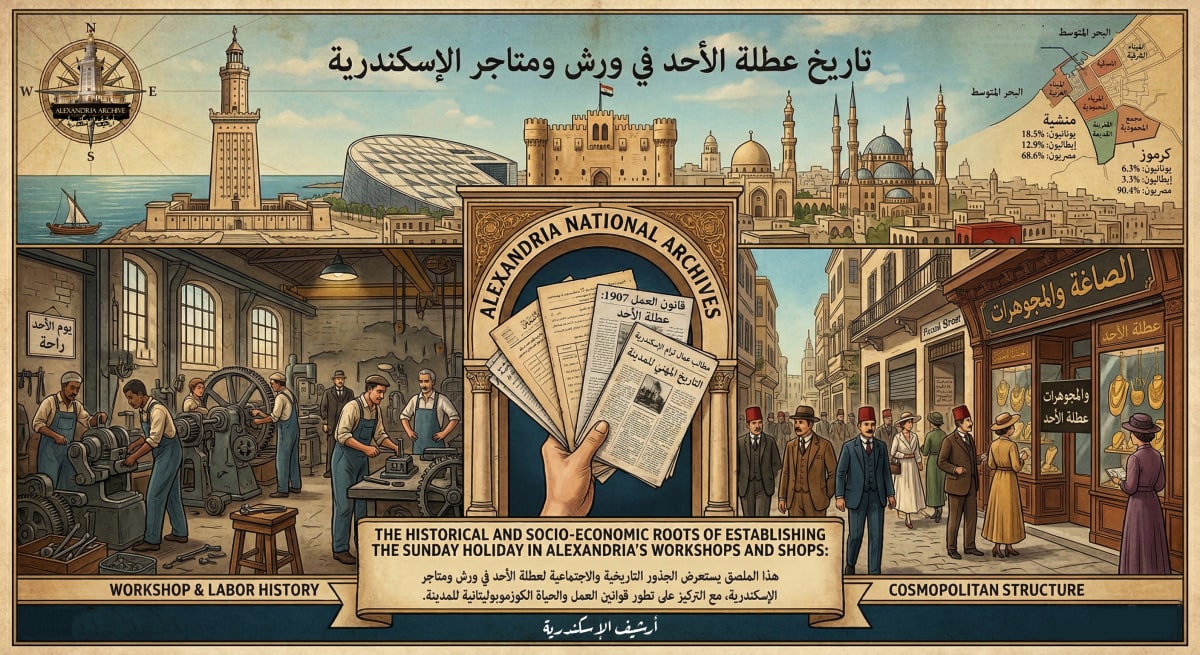
The Historical and Socio-Economic Roots of Establishing the Sunday Holiday in Alexandria's Workshops and Shops: A Documentary Study in Labor History and Cosmopolitan Structure
Eslam Ali —
مقدمة تأصيلية: فلسفة الزمن الحضري والإسكندرية كبوتقة للتعددية
إن دراسة إيقاع الزمن الاقتصادي والاجتماعي في الحواضر الكبرى لا يمكن أن تنفصل بأي حال من الأحوال عن تاريخها الحضاري، والديموغرافي، والعمالي العميق. فالزمن في المدن ليس مجرد أرقام تدق على ساعة الحائط، بل هو تراكم هيكلي لطبقات من الممارسات الثقافية، وقرارات رأس المال، ونضالات الطبقة العاملة. وفي سياق مدينة الإسكندرية، يُعد تحديد أيام العطلات والراحات الأسبوعية في الأسواق المحلية، وتحديداً ظاهرة إغلاق الورش الحرفية والمحلات التجارية يوم الأحد، واحداً من أبرز الظواهر السوسيو-اقتصادية التي تعكس هذا التراكم. إن هذا اليوم الذي يشهد إغلاقاً طوعياً وعرفياً لقطاعات واسعة من السوق السكندري ليس مجرد قرار إداري أو صدفة عابرة، بل هو انعكاس تراكمي لتحولات هيكلية في تركيبة المدينة السكانية، ونظامها الرأسمالي الحديث، وتاريخ الحركة العمالية فيها منذ أواخر القرن التاسع عشر.
تأسست الإسكندرية في عام 331 قبل الميلاد على يد الإسكندر الأكبر، وسرعان ما تحولت إلى العاصمة الفكرية والتجارية للمتوسط في العصر الهلنستي، محتضنة فسيفساء معقدة من الثقافات اليونانية، والرومانية، والمصرية، واليهودية. هذا الإرث التعددي لم يندثر مع تعاقب الإمبراطوريات، بل تبلور في شكل جديد ومكثف خلال العصر الحديث. ومع مطلع القرن التاسع عشر، ونتيجة لسياسات الانفتاح الاقتصادي والتحديث التي قادها محمد علي باشا، استعادت الإسكندرية مكانتها كمركز تجاري عالمي يربط مصر بالأسواق الأوروبية عبر شق ترعة المحمودية وتطوير الميناء لاستيعاب تجارة القطن والحبوب. أدى هذا الانفتاح إلى تدفق هائل للجاليات الأجنبية وتأسيس مجتمع "كوزموبوليتاني" فريد من نوعه أفرز ديناميكيات اجتماعية واقتصادية شديدة التعقيد. هذا الوجود الديموغرافي الكثيف للأجانب لم يؤثر فقط على العمارة والثقافة، بل أعاد هندسة "وقت العمل" (Labor Time) في المدينة. تهدف هذه الدراسة الأرشيفية المعمقة إلى تفكيك الأسباب التاريخية، والدينية، والتنظيمية التي رسخت يوم الأحد كعطلة رسمية غير مكتوبة لقطاعات واسعة من الورش الحرفية والأسواق التجارية في الإسكندرية، معتمدة على التدقيق التاريخي للوثائق وقوانين العمل وتطور طبقة الحرفيين.
الجذور الميثولوجية والدينية: كيف تكرس "الأحد" كيوم للراحة الكونية؟
قبل الغوص في خصوصية الحالة السكندرية، يتطلب التدقيق التاريخي تتبع الأصل المفهومي ليوم الأحد (Sunday) وارتباطه بالراحة أو التقديس. يمتد الجذر الديني والثقافي ليوم الأحد إلى التقاليد الميثولوجية والدينية القديمة. ففي مصر القديمة، ارتبط هذا المفهوم بعبادة إله الشمس "رع"، حيث كان يُنظر إلى الشمس ليس فقط كجرم سماوي، بل ككائن إلهي ينظم إيقاع الحياة والموت، ويقود قاربه الشمسي عبر العالم السفلي (دوات) ليواجه قوى الفوضى وينتصر عليها ليشرق من جديد. وفي السياق الأسطوري الإسكندنافي (النوردي)، تم تكريم آلهة الشمس "سول" (Sól) التي تجوب السماء في عربتها التي تطاردها الذئاب الكونية.
ومع التطور التاريخي، تبلورت الرمزية الكونية ليوم الأحد في العقيدة المسيحية ليصبح يوم القيامة (Resurrection Sunday) أو يوم انتصار المسيح على الموت، وهو ما جعله محورياً في التقويم المسيحي. تاريخياً، كان المسيحيون الأوائل في شرق الإمبراطورية يربطون احتفالاتهم بعيد الفصح اليهودي، إلا أن مجمع نيقية حسم هذا الأمر بتوحيد الاحتفال بيوم الأحد ليكون اليوم الرسمي للعبادة وإقامة القداسات، وهو قرار ذو طابع لاهوتي وتنظيمي استمر تأثيره حتى اليوم.
في الإسكندرية تحديداً، يكتسب هذا اليوم أهمية مضاعفة. فالمدينة تحتضن الكرسي المرقسي الذي تأسس على يد القديس مرقس الرسول في عام 61 ميلادياً، والذي أدخل المسيحية إلى مصر وأسس مدرسة الإسكندرية اللاهوتية التي أصبحت منارة التعليم المسيحي في العالم القديم. هذا التجذر العميق للمسيحية (الأرثوذكسية القبطية، ثم لاحقاً الكاثوليكية واليونانية الأرثوذكسية) جعل من يوم الأحد يوماً مقدساً يشهد توقفاً عن العمليات الدنيوية للتوجه إلى دور العبادة والتجمعات العائلية في الأندية الاجتماعية والكنسية.
التركيبة الديموغرافية والمهنية للإسكندرية في العصر الكوزموبوليتاني
لفهم الآلية التي تحول بها يوم الأحد من يوم عبادة ديني إلى عرف اقتصادي صارم في الأسواق السكندرية، يجب تحليل بنية الملكية ورأس المال في المدينة خلال أواخر القرن التاسع عشر وأوائل القرن العشرين. في تلك الحقبة، كما وصفها الكاتب مارك توين في عام 1867، كانت الإسكندرية تبدو كمدينة أوروبية تعج بالمباني التجارية الضخمة والشوارع المضاءة بالغاز، لدرجة أنها كانت تذكر الزائرين بمدينة باريس. شهدت تلك الفترة هيمنة شبه كاملة للجاليات الأوروبية، وعلى رأسها اليونانيون والإيطاليون، على القطاعات التجارية والصناعية الكبرى والحرفية الدقيقة.
بحلول أوائل القرن العشرين، كان عدد اليونانيين في الإسكندرية يتجاوز 120,000 نسمة، وتشير بعض تقديرات إدارة الجالية اليونانية بالإسكندرية (EKA) إلى أن عددهم بلغ في أوج ازدهارهم في أوائل الخمسينيات حوالي 200,000 نسمة. شكل اليونانيون أكبر جالية أجنبية، وأسسوا بنية تحتية اقتصادية واجتماعية هائلة شملت أندية رياضية، ومستشفيات، وشركات كبرى لحلج القطن مثل شركة (Associated Cotton Ginners of Egypt Ltd) وشركة كفر الزيات للقطن التي أدارتها عائلات يونانية وإنجليزية، فضلاً عن المحلات التجارية والمقاهي التي انتشرت في أحياء كحي الإبراهيمية الذي عُرف حينها بـ "باريس الصغيرة".
إلى جانب اليونانيين، برزت الجالية الإيطالية التي بلغ تعدادها حوالي 55,000 نسمة في ثلاثينيات القرن العشرين، والتي امتلكت نفوذاً واسعاً في مجالات العمارة، والمقاولات، والورش الميكانيكية. وقد انعكس هذا التواجد الديموغرافي الثقيل على هيكل الملكية للورش والمصانع. تُظهر البيانات الأرشيفية المبنية على التقرير الرسمي العثماني لمصر لعام 1871 (Mısır Sâlnâmesi 1871) والدراسات اللاحقة لتوزيع المهن لعام 1907، تفوقاً واضحاً للأجانب في امتلاك الورش الميكانيكية ومسابك المعادن، وهي القطاعات التي تشكل النواة الصلبة لما يُعرف بـ "الورش" في الشارع السكندري المعاصر.
<table><tbody><tr><td><strong>قطاع النشاط الصناعي والمهني (الإسكندرية 1907)</strong></td><td><strong>نسبة الملكية الأوروبية</strong></td><td><strong>نسبة الملكية المحلية والإقليمية</strong></td><td><strong>ملاحظات وتداعيات أرشيفية</strong></td></tr><tr><td>مسابك المعادن (Foundries)</td><td>50%</td><td>35% (مصريون)</td><td>شكلت المسابك أساس الصناعات الثقيلة والحرفية المعدنية، وكان النفوذ الأوروبي فيها حاسماً في تنظيم دورة العمل.</td></tr><tr><td>الورش الآلية والميكانيكية (Machine Shops)</td><td>سيطرة واسعة (إيطالية ويونانية)</td><td>تواجد ملحوظ</td><td>تضمنت هذه الورش أيضاً نسبة ملكية يهودية بلغت حوالي 30%، مما خلق تنوعاً في أيام الراحة انتهى بتوحيدها.</td></tr><tr><td>قطاع الخردة والمهن الملحقة التوريدية</td><td>أغلبية أجنبية</td><td>أقلية وطنية</td><td>اتبع نفس النمط الديموغرافي للمسابك، مما فرض التزامن في أيام العمل لضمان استمرار سلاسل التوريد.</td></tr></tbody></table>
إن هذه الأغلبية العددية والنوعية في ملكية وسائل الإنتاج والورش الحرفية منحت الأجانب القوة الهيكلية لفرض إيقاعهم الثقافي والديني على دورة العمل الأسبوعية. فقد كان من الطبيعي والمنطقي أن تغلق هذه الورش أبوابها في اليوم الذي يقدسه ملاكها ويخصصونه للراحة والذهاب للكنيسة أو الأندية، وهو ما مهد الطريق تدريجياً لتعميم عطلة الأحد لتشمل كافة العاملين.
النفوذ المؤسسي للجاليات وأثره على الثقافة العمالية
لم يكن تأثير الجاليات الأجنبية عشوائياً، بل كان مدعوماً مؤسسياً من دولهم الأم. في مارس 1933، زار الملك الإيطالي فيتوريو إيمانويل الثالث مدينة الإسكندرية لافتتاح مدارس (Scuole Littorie Italiane)، وهي خطوة كانت تهدف إلى دمج الجالية الإيطالية في المشروع القومي والفاشي الإيطالي وتعميق الروابط مع الوطن الأم. هذا الدعم المؤسسي جعل الجالية الإيطالية، التي كانت تسيطر على قطاعات البناء والميكانيكا والكهرباء، أشد تمسكاً بتقاليدها الأوروبية، ومن ضمنها عطلة نهاية الأسبوع يوم الأحد، وهو ما فُرض بالتبعية على العمال والصبيان المصريين الذين كانوا يتعلمون سر الصنعة في هذه الورش. وبفضل هذا الاحتكاك اليومي، تشرب العامل الحرفي المصري نظام العمل الأوروبي، وأصبح يوم الأحد في وجدانه المهني هو يوم "توقف الماكينات" والراحة الإجبارية.
انهيار نظام الطوائف الحرفية وتأسيس الحركة العمالية الحديثة
لا يمكن تفسير تثبيت عطلة الأحد فهماً دقيقاً دون التطرق إلى التحول الراديكالي الذي أصاب البنية العمالية المصرية في أواخر القرن التاسع عشر. لعقود طويلة قبل التغلغل الأوروبي، كان العمل الحرفي والتجاري في مصر يُنظم عبر ما عُرف بـ "طوائف الحرف" (Guilds). كانت هذه الطوائف كيانات تقليدية هرمية يشرف عليها "شيخ الطائفة"، وتتولى تنظيم الإنتاج، ومراقبة جودة السلع، وتحديد الأسعار، وفض المنازعات، وتنظيم أوقات العمل والإجازات التي كانت ترتبط ارتباطاً وثيقاً بالمواسم الدينية والأعياد الإسلامية الكبرى والموالد.
وكما يوضح الباحث والأكاديمي جابرييل بير (Gabriel Baer) في دراسته المرجعية المعمقة "نقابات الحرف المصرية في العصر الحديث" (Egyptian Guilds in Modern Times - 1964)، فقد غطت هذه الطوائف كافة مناحي الحياة الاقتصادية؛ من طائفة باعة الكتب (الصحافين) إلى طائفة صاقلي الورق (السقالين) الذين كانوا يستخدمون تقنيات لحفظ الورق من التلف، وصولاً إلى طوائف الإسكافيين والحمالين. لعبت هذه الطوائف أدواراً سياسية واجتماعية هامة، من ضمنها مساندة الثورة العرابية في عام 1882 للحصول على سلطة برلمانية أوسع ومواجهة النفوذ الشركسي والتركي والتدخل الأجنبي. كانت العطلات في ظل نظام الطوائف مرنة وتدور حول التقويم الإسلامي والزراعي، حيث كانت أوقات الراحة تُحدد بناءً على مواسم الحصاد والأعياد المرتبطة بالتقويم الهجري وأحياناً اليولياني في الأرياف.
إلا أن التحولات الرأسمالية الحادة، ودخول الميكنة، وضغط التدخل الأجنبي أدى في النهاية إلى صدور أمر خديوي بإلغاء نظام طوائف الحرف رسمياً في 9 يناير 1890، مما أقر مبدأ حرية احتراف أي مهنة دون اشتراط الانخراط كتلميذ (صبي) تحت لواء شيخ الطائفة. أحدث هذا الانهيار فراغاً تنظيمياً وثقافياً هائلاً ملأته سريعاً آليات العمل الرأسمالي الحديث الذي تديره الشركات الأجنبية والورش الكبرى في الإسكندرية. تحول الحرفي المصري بين ليلة وضحاها من عضو في طائفة تحميه التقاليد إلى "عامل مأجور" يخضع لنظام ساعات العمل الصارم الذي يفرضه النموذج الرأسمالي الغربي.
إضرابات عام 1900 ومأسسة حق الراحة الأسبوعية كفعل نضالي
مع تزايد استغلال العمال في ظل النظام الرأسمالي الجديد، وغياب الحماية التي كانت توفرها الطوائف، بدأت تتبلور ملامح طبقة عاملة مصرية حديثة تعي حقوقها وتستخدم أدوات الاحتجاج المعاصرة كالإضراب. في هذا السياق التاريخي الدقيق، لم تُمنح عطلة الأحد كمنحة طوعية فقط من أرباب العمل الأجانب، بل تحولت إلى حق مُكتسب تم النضال من أجله.
يشير الأرشيف العمالي إلى موجة عارمة من الإضرابات الكبرى التي اجتاحت الإسكندرية والقاهرة في عام 1900، شملت عمال الترام، وعمال ميناء الإسكندرية، وشركة الأهلية للغزل والنسيج، ومطابع كوريدي. كان من أبرز مطالب المضربين في الإضراب التاريخي لعمال ترام الإسكندرية في نوفمبر 1900، إلى جانب وضع معدلات أجر منتظمة بالقطعة (Piece rate) وتقليل ساعات العمل المنهكة، هو الحصول صراحة على "عطلة بعد ظهر يوم الأحد" (Sunday afternoon off)، بالإضافة إلى فترات راحة منتظمة لتناول الطعام وتحسين فرص الترقية للعمال المصريين.
هذا المعطى التاريخي البالغ الأهمية، والمستمد من دراسات تشكيل الطبقة العاملة المصرية، يكشف بوضوح أن العامل المصري أدرك أن الإيقاع الزمني للمدينة قد أصبح مرتبطاً بالنموذج الغربي وعطلته الأسبوعية (الأحد)، وبدلاً من التمرد العشوائي عليه، طالب بتطبيقه على العمالة المحلية لتأمين فترة راحة جسدية واجتماعية تعوضه عن غياب حماية الطوائف القديمة. وبذلك، تم دمج يوم الأحد لأول مرة في صميم الوعي الحقوقي والنقابي للعمالة الصناعية والحرفية في الإسكندرية ومصر عموماً.
على الرغم من أن حركة التجارة العامة بدأت تتخذ أشكالاً متنوعة من العطلات بعد تحولات القرن العشرين، إلا أن الإسكندرية وكبريات المحافظات المصرية احتفظت بإغلاق تام يوم الأحد في قطاعين اقتصاديين رئيسيين لأسباب تتعلق بآليات السوق وسلاسل التوريد:
1. سوق الذهب والمجوهرات (الصاغة)
تُعد تجارة الذهب وتصنيعه من أكثر الأسواق حساسية للتقلبات الاقتصادية، وتتطلب تزامناً دقيقاً (Market Synchronization) في حركة البيع والشراء لضبط التسعير اليومي. تاريخياً، تمركزت هذه المهنة الدقيقة في أيدي عائلات يهودية ومسيحية (من الأرمن، والشوام، واليونانيين، والأقباط) في الإسكندرية والقاهرة. ونظراً لأن سوق الذهب العالمي يعتمد عطلة نهاية الأسبوع السبت والأحد كأيام توقف للتداول في البورصات العالمية، ومع استقرار الغالبية المسيحية في المهنة محلياً بعد الهجرات المتتالية للجالية اليهودية، أصبح إغلاق الصاغة يوم الأحد عرفاً حديدياً لا يمكن تجاوزه.
وحتى في العصر الحالي، عندما يمر السوق المحلي بحالة ركود أو اضطراب حاد في التسعير تضطر فيه المحلات لوقف البيع والشراء لتقليل الخسائر المادية—كما يحدث في فترات تذبذب الجنيه المصري مقابل الدولار حيث يتحاشى التاجر بيع مخزونه خشية عدم قدرته على تعويضه مالياً—يظل يوم الأحد هو يوم التوقف المنهجي المعتمد لترتيب الحسابات والموازين وضبط أسعار الافتتاح للأسبوع الجديد. ويشير خبراء السوق إلى أن هامش الربح لتاجر الذهب (المصنعية) يتراوح بين 30 إلى 40 جنيهاً في الجرام، بينما قد يقفز فارق السعر فجأة إلى 150 جنيهاً، مما يجعل أي عملية بيع غير متزامنة مع السوق العالمي والمحلي خسارة فادحة.
وقد رسخ هذا العرف نفسه بقوة لدرجة أن وزارة التنمية المحلية المصرية، عند إصدارها لقرارات تنظيم مواعيد عمل المحلات في الأعياد كعيد الفطر، تتعامل مع دورة عمل الصاغة كدورة ذات طبيعة خاصة؛ حيث تسمح لها بامتداد العمل حتى الثانية فجراً ليلة العيد، لكنها تقر ضمناً واعتباراً بأن يوم العيد الأول أو يوم الأحد هو يوم إغلاق اعتيادي تتوقف فيه غالبية محلات الصاغة والمجوهرات عن استقبال العملاء.
2. الورش الميكانيكية والحرف الصناعية الدقيقة
يقف شارع فؤاد (طريق الحرية حالياً) والأحياء المحيطة به في قلب الإسكندرية كشاهد حي على التراث المعماري والحرفي الأوروبي. في هذه الشوارع ذات العمارة التي تعود لأسلوب عصر النهضة الجديد (Neo-Renaissance)، ازدهرت قديماً ورش إصلاح السيارات الكلاسيكية، وصيانة المحركات، والميكانيكا الدقيقة التي أنشأها مهندسون وحرفيون إيطاليون ويونانيون لخدمة النخب المحلية، بل وحتى لخدمة أسطول سيارات العائلة المالكة في عهد الملك فؤاد الأول الذي توفي عام 1936.
إن نموذج "الأسطى" أو "الخواجة" الأوروبي الذي كان يدير ورشته بصرامة متناهية، كان يفرض إغلاق الورشة بالكامل يوم الأحد للراحة، والتنزه على الكورنيش، أو ارتياد المقاهي اليونانية كـ "أثينيوس" والأندية الاجتماعية، أو زيارة الكنائس. وعندما تشرب "الصبي" المصري سر الصنعة وارتقى ليصبح هو "الأسطى" والمالك للورشة، ورث مع المعرفة الفنية الممارسة الزمنية للورشة. وبات التوقف يوم الأحد طقساً مهنياً مقدساً يربط الحرفي بجذور مهنته، واحترامه لتقاليدها الموروثة، وشعوره بالانتماء لطبقة مهنية متميزة، حتى بعد مغادرة الأجانب لمصر في منتصف القرن العشرين.
يبرز هذا كاستنتاج تحليلي من الدرجة الثانية: لم يكن استمرار عطلة الأحد في الورش بعد رحيل الأجانب مجرد جمود وظيفي أو تقليد أعمى، بل كان دليلاً سوسيولوجياً على أن الطبقة العاملة المصرية قد استحوذت على "رأس المال الثقافي والزمني" الأجنبي، وصهرته في بوتقتها، واعتبرته جزءاً لا يتجزأ من هويتها الحرفية المستقلة التي تميزها عن باقي المهن.
التحولات السياسية وقانون العمل المصري: استيعاب التراث وتأطيره تشريعياً
مع اندلاع ثورة يوليو 1952 والتغيرات السياسية الجذرية والجيوسياسية التي تلتها، وخاصة قرار تأميم الشركة العالمية لقناة السويس البحرية الذي أعلنه الرئيس جمال عبد الناصر من ميدان المنشية بالإسكندرية عام 1956، وما تلاه من عدوان ثلاثي، تعرض العصر الكوزموبوليتاني السكندري لضربة قاصمة. فُرضت قوانين التأميم والتمصير، وصودرت ممتلكات، وغادرت الجاليات الأجنبية (اليونانية، الإيطالية، البريطانية، والفرنسية، بالإضافة إلى الجالية اليهودية) مصر في هجرات جماعية قسرية أو طوعية، تاركة وراءها فراغاً ديموغرافياً ملأه المصريون بالكامل، لتتحول التركيبة السكانية للمدينة إلى تركيبة مصرية خالصة تقريباً.
هنا يطرح سؤال منهجي وتاريخي جوهري نفسه: لماذا لم تتحول الورش والمحلات فوراً إلى الإغلاق يوم الجمعة بدلاً من الأحد، تماشياً مع العطلة الإسلامية الرسمية التي تتبعها الدواوين الحكومية والوزارات في مصر؟.
تكمن الإجابة في التطور التشريعي الفطن لقوانين العمل في مصر والمناخ الاقتصادي للقطاع الخاص. فالدولة المصرية، بوزاراتها ومكاتبها الحكومية وقطاعها العام، اتخذت يوم الجمعة (ولاحقاً أُضيف السبت في العديد من الهيئات) عطلة رسمية تماشياً مع الشعائر الدينية الإسلامية. إلا أن المشرّع المصري عند صياغة قوانين العمل المتعاقبة للقطاع الخاص، اتسم بمرونة فائقة تجاه القطاع التجاري والصناعي الخاص لضمان عدم الإخلال بعجلة الإنتاج أو الاصطدام بالأعراف التجارية المستقرة.
منذ بدايات تبلور التشريعات العمالية، مروراً بالقانون رقم 91 لسنة 1959، ثم قانون العمل رقم 137 لسنة 1981 في عهد الرئيس مبارك والذي نظم عمل القطاع الخاص، وصولاً إلى قانون العمل الشامل رقم 12 لسنة 2003 وتعديلاته اللاحقة، أقر المشرع مجموعة واسعة من الإجازات.
<table><tbody><tr><td><strong>نوع الإجازة في قانون العمل المصري (القطاع الخاص)</strong></td><td><strong>المدد والشروط القانونية</strong></td><td><strong>المرجعية التشريعية والغرض التنظيمي</strong></td></tr><tr><td>العطلات والمناسبات الرسمية</td><td>13 إلى 14 يوماً سنوياً بأجر كامل</td><td>تحدد بقرار وزاري (مثل شم النسيم، عيد العمال، الأعياد الدينية والقومية) مع جواز تشغيل العامل بأجر مضاعف.</td></tr><tr><td>الإجازة السنوية الاعتيادية</td><td>21 يوماً تصل إلى 30 يوماً</td><td>تزداد إلى شهر كامل لمن أمضى 10 سنوات تأمينية أو تجاوز سن الخمسين.</td></tr><tr><td>الإجازة العارضة</td><td>6 أيام كحد أقصى (لا تزيد عن يومين متصلين)</td><td>تُخصم من الرصيد السنوي وتُمنح لأسباب قهرية خارجة عن إرادة العامل.</td></tr><tr><td>إجازة الحج وزيارة بيت المقدس</td><td>شهر كامل مرة واحدة طوال مدة الخدمة</td><td>تُمنح بعد مضي 5 سنوات متتالية في خدمة صاحب العمل لأداء الشعائر.</td></tr><tr><td>إجازة الأمومة</td><td>90 يوماً مدفوعة الأجر</td><td>تُمنح للعاملة التي أمضت 10 أشهر، وتشمل الفترة السابقة واللاحقة للوضع.</td></tr><tr><td>الراحة الأسبوعية</td><td>24 ساعة متصلة على الأقل</td><td>حق أصيل للعامل، <strong>دون إلزام قانوني بتوحيد اليوم على مستوى كافة القطاعات</strong>.</td></tr></tbody></table>
كما هو موضح في البنية التشريعية، لم يجبر القانون المُشرِّع أصحاب الورش، أو المحلات الخاصة، أو الكيانات غير الحكومية على توحيد الراحة الأسبوعية لتكون يوم الجمعة حصراً. هذا الفراغ التشريعي المدروس والمتروك للتنظيم الداخلي للمنشآت، أتاح للغرف التجارية، والروابط الحرفية، والأسواق المجمعة (مثل أسواق الذهب، قطع غيار السيارات، ورش الأخشاب، ومراكز الميكانيكا) الاستمرار بمرونة على العرف التجاري السائد الموروث.
وقد كان هذا العرف التجاري مدفوعاً بضرورات حتمية تتمثل في "التكامل البيني" أو ما يُعرف اقتصادياً بـ "تأثير الشبكة" (Network Effect). إذ لا يمكن لورشة خراطة، على سبيل المثال، أن تعمل بكفاءة يوم الأحد إذا كان مورد قطع الغيار، أو تاجر الخردة، أو مسابك الحديد المجاورة مغلقة في نفس اليوم. هذا الترابط العضوي اضطر جميع المنخرطين في حلقة التوريد (Supply Chain) للحرف الميكانيكية والصناعية للحفاظ على يوم الأحد كإجازة منسقة للجميع، لتجنب شلل الإنتاج الفردي وهدر الموارد التشغيلية. وفي المقابل، نجد أن قطاعات مهنية أخرى تقدم خدمات فردية مباشرة للمستهلك، كبعض صالونات الحلاقة وتصفيف الشعر، اتخذت من يوم الإثنين عطلة أسبوعية بديلة لها؛ وذلك استراتيجياً لتجنب الإغلاق في أيام ذروة الإقبال وتجهيزات المناسبات التي تقع عادة أيام الخميس والجمعة والسبت والأحد. بينما التزمت البنوك وبعض المعاهد الخاصة بعطلة السبت والأحد لتتزامن عملياتها المالية والإدارية مع النظام المصرفي والأسواق العالمية.
الأثر الممتد: الإسكندرية اليوم، استعادة الذاكرة وتحديات الإدارة الحديثة
رغم أن مدينة الإسكندرية المعاصرة شهدت تغييرات ديموغرافية وحضرية واسعة، وأصبحت مدينة مزدحمة تعاني بعض أحيائها من التدهور العمراني، وتواجه صراعات مستمرة بين التحديث العمراني التجاري والحفاظ على التراث (كما تبين المبادرات المعمارية المستقلة لإنقاذ المباني ذات الطراز الكلاسيكي في شارع فؤاد وتحويلها إلى مساحات ثقافية وتجارية كممر L Passage بقيادة شركات متخصصة في التراث) ، فإن الإيقاع الزمني والاجتماعي للمدينة لا يزال وفياً لتاريخه العميق. تُظهر الفعاليات الثقافية البارزة، مثل "أيام التراث السكندري" (Alexandria Heritage Days) التي ينظمها المعهد الفرنسي بالتعاون مع جهات محلية، كيف أن الإسكندرية تعتز بطبقاتها التاريخية المتعددة؛ فهي كما توصف دائماً مدينة "لا تموت أبداً"، تتكون من طبقات متراكمة، تتلقى الأزمات وتعيد بناء هويتها من رماد التحولات التاريخية.
يُمثل توقف العمل يوم الأحد في ورش ومحلات الإسكندرية نوعاً من "الأرشفة السلوكية" الحية في الشارع المصري. فبينما تقف المباني الحجرية والفيلات الأنيقة كشواهد مادية صامتة على العمارة اليونانية والإيطالية والفرنسية التي سادت في عصور سابقة ، تقف العادات التجارية والمهنية كشاهد غير مادي ينبض بالحياة على الاندماج العميق للعمالة المصرية مع النظم الرأسمالية الأجنبية في مطلع القرن العشرين.
وفي أوقات الأزمات الوطنية الراهنة وتحديات البنية التحتية، تظهر أهمية هذا الإيقاع الزمني بوضوح. فعلى سبيل المثال، في الفترات التي لجأت فيها الحكومة المصرية إلى تنفيذ خطط طوارئ لتخفيف أحمال الكهرباء وترشيد الاستهلاك في فصل الصيف، أصدر رئيس الوزراء قرارات تقضي بعمل موظفي الوزارات والمصالح الحكومية غير الخدمية بنظام "الأونلاين" (العمل عن بعد من المنزل) يوم الأحد من كل أسبوع. هذا الاختيار الحكومي ليوم الأحد تحديداً لم يكن اعتباطياً، بل لأن الدولة استغلت بذكاء هذا اليوم كمتغير مرن لضبط إيقاع الاستهلاك القومي، مستفيدة من الانخفاض المسبق والموروث في النشاط التجاري والحرفي العام في قطاعات الورش والصاغة خلال هذا اليوم، مما يضاعف من كفاءة خطة تخفيف الأحمال. حتى أن مؤسسات ثقافية عملاقة مثل مكتبة الإسكندرية (Bibliotheca Alexandrina) قامت بتعديل مواعيد العمل الرسمية واستقبال الجمهور لتتماشى مع هذه القرارات ولتتوافق مع تقليص النشاط الحضري يومي السبت والأحد.
علاوة على ذلك، في عصر الرقمنة والشركات العابرة للحدود، أصبحت تعقيدات إدارة الإجازات في القطاع الخاص المصري اليوم تتطلب أنظمة إدارة موارد بشرية متقدمة وأنظمة رواتب معقدة قادرة على تتبع العطلات الرسمية المحددة حكومياً، والأعياد الدينية المتغيرة بناءً على التقويم القمري، والراحات الأسبوعية المتباينة جذرياً بين قطاع وآخر أو بين القاهرة والإسكندرية (حيث تتداخل عطلات الجمعة، السبت، أو الأحد حسب طبيعة النشاط). وقد أظهرت الإحصاءات الإدارية الحديثة أن غياب التزامن واعتماد أنظمة يدوية أو مفككة في إدارة الورديات والأجور في ظل هذه التعقيدات الموروثة، يكبد الشركات خسائر مالية متراكمة؛ إذ أن الأخطاء المحاسبية في جداول الرواتب (Payroll errors) المرتبطة بالإجازات تكلف المؤسسات أموالاً طائلة، مما يُبرز الحيوية المستمرة والأهمية البالغة لضبط جداول العطلات المؤسسية وفهم جذورها التشغيلية.
الخلاصة والتوصيات الأرشيفية
من خلال الاستقصاء المعمق في تاريخ العمل، والتكوين الديموغرافي، والبنية التشريعية لمدينة الإسكندرية ومصر الحديثة، نخلص في هذا التوثيق الأرشيفي إلى الاستنتاجات التالية التي تضع ظاهرة إغلاق الورش والمحلات يوم الأحد في إطارها العلمي والتاريخي الصحيح:
الاستنساخ الثقافي والمهني كأداة هيكلية: لم يكن إقرار يوم الأحد كعطلة رئيسية لقطاعات الورش والمحلات قراراً سيادياً مباشراً من الإدارة المصرية، بل كان نتاجاً عضوياً لهبوط وتوغل رأس المال الكوزموبوليتاني (تحديداً اليوناني والإيطالي والفرنسي) في بنية الاقتصاد المحلي خلال القرن التاسع عشر وأوائل العشرين. وفي ظل امتلاك الأجانب للأغلبية الساحقة من المصانع، والمسابك، والورش الدقيقة، فرض أرباب العمل إجازتهم الدينية والثقافية الغربية كمعيار لا غنى عنه لإيقاع السوق، وهو ما أُجبرت العمالة المحلية على تبنيه والاندماج فيه.
انتقال السلطة الزمنية من الطوائف إلى النقابات: بالتزامن مع القرار التاريخي بإلغاء نظام "طوائف الحرف" العثمانية في عام 1890 ، أصبح العمال المصريون خاضعين ومكشوفين أمام نظام صناعي رأسمالي جديد جردّهم من إجازاتهم التقليدية. وتُمثل إضرابات عام 1900 العمالية الكبرى في الإسكندرية للمطالبة بـ "عطلة منتصف يوم الأحد" نقطة تحول حاسمة؛ إذ تشكل دليلاً دامغاً على تحول هذه العطلة من مجرد "ممارسة أجنبية مفروضة" إلى "حق عمالي مصري أصيل" تم انتزاعه بالنضال النقابي لضمان راحة جسدية للعامل.
تأثير الشبكات والتزامن الاقتصادي: إن احتفاظ قطاعات الصاغة والورش الميكانيكية بالذات بهذه العطلة حتى يومنا هذا، رغم التغيرات الديموغرافية، يُعزى بشكل مباشر إلى ضرورة التزامن العملياتي (Operational Synchronization). فالارتباط المعقد والمتشابك لسلاسل التوريد (تجار خردة، مسابك، ورش قطع غيار، محلات ذهب وبورصات) منع أي نزعة فردية في التمرد على هذا اليوم، حيث أن فتح منشأة واحدة في يوم تُغلق فيه باقي عناصر الدورة الاقتصادية لا يعدو كونه هدراً تشغيلياً لا طائل منه.
المرونة التشريعية والذكاء التنظيمي المصري: لعبت قوانين العمل المصرية المتتالية (بدءاً من منتصف القرن العشرين وصولاً إلى قانون 12 لسنة 2003) دوراً تشريعياً شديد الذكاء في الحفاظ على هذا الإرث، وذلك عبر الامتناع المتعمد عن فرض "يوم جمعة إجباري" على منشآت القطاع الخاص كراحة أسبوعية، مكتفية بتشريع حق العامل في الراحة دون تحديد اليوم. هذا الموقف التشريعي المرن سمح للمجتمع التجاري والصناعي بإدارة أوقاته ذاتياً بناءً على تقاليده الموروثة وديناميكيات أسواقه المتخصصة. إن التوثيق العلمي لظاهرة "إجازة الأحد" في أرشيف مدينة الإسكندرية هو أبعد ما يكون عن مجرد رصد روتيني لمواعيد العمل التجارية؛ إنه قراءة عميقة في جينوم المدينة الثقافي والاقتصادي. فهذه العادة تثبت أن المجتمعات المحلية العريقة لا تقوم باستيعاب التغيير والتأثيرات الوافدة فحسب، بل تصهرها، وتعيد إنتاجها، وتورثها لتصبح جزءاً من كينونتها الذاتية وهويتها العمالية. وعليه، يُوصى بتضمين هذا السرد التاريخي المفصل ضمن المناهج التوثيقية لـ "أيام التراث السكندري"، واعتبار العادات السلوكية المهنية، والإيقاع الزمني للأسواق، جزءاً أصيلاً لا يتجزأ من التراث اللامادي الذي يستوجب الفحص، والدراسة، والحماية كبقية الآثار المعمارية والكلاسيكية التي تزخر بها المدينة.
Here is the full translation of the text:
Foundational Introduction: The Philosophy of Urban Time and Alexandria as a Melting Pot of Pluralism
Studying the rhythm of economic and social time in major metropolises cannot in any way be separated from their deep civilizational, demographic, and labor history. Time in cities is not just numbers ticking on a wall clock; it is a structural accumulation of layers of cultural practices, capital decisions, and working-class struggles. In the context of the city of Alexandria, determining the days of holidays and weekly rest in local markets, specifically the phenomenon of closing artisan workshops and commercial shops on Sunday, is one of the most prominent socio-economic phenomena reflecting this accumulation. This day, which witnesses a voluntary and customary closure of wide sectors of the Alexandrian market, is not merely an administrative decision or a passing coincidence; rather, it is a cumulative reflection of structural transformations in the city's demographic makeup, its modern capitalist system, and the history of its labor movement since the late 19th century.
Alexandria was founded in 331 BC by Alexander the Great and rapidly transformed into the intellectual and commercial capital of the Mediterranean in the Hellenistic era, embracing a complex mosaic of Greek, Roman, Egyptian, and Jewish cultures. This pluralistic legacy did not vanish with the succession of empires but crystallized in a new and intensified form during the modern era. By the early 19th century, as a result of the economic openness and modernization policies led by Muhammad Ali Pasha, Alexandria regained its status as a global commercial hub connecting Egypt to European markets through the digging of the Mahmoudiyah Canal and the development of the port to accommodate the cotton and grain trade. This openness led to a massive influx of foreign communities and the establishment of a unique "cosmopolitan" society that produced highly complex social and economic dynamics. This dense demographic presence of foreigners did not only affect architecture and culture but re-engineered "Labor Time" in the city. This in-depth archival study aims to deconstruct the historical, religious, and organizational reasons that entrenched Sunday as an unwritten official holiday for broad sectors of artisan workshops and commercial markets in Alexandria, relying on the historical scrutiny of documents, labor laws, and the evolution of the artisan class.
Mythological and Religious Roots: How Did "Sunday" Become Consecrated as a Day of Cosmic Rest?
Before diving into the specificity of the Alexandrian case, historical scrutiny requires tracing the conceptual origin of Sunday and its association with rest or sanctification. The religious and cultural root of Sunday extends to ancient mythological and religious traditions. In ancient Egypt, this concept was linked to the worship of the sun god "Ra," where the sun was viewed not merely as a celestial body but as a divine entity regulating the rhythm of life and death, guiding his solar barque through the underworld (Duat) to confront and defeat the forces of chaos, only to rise again. In the Scandinavian (Norse) mythological context, the sun goddess "Sól" was honored as she traversed the sky in her chariot, chased by cosmic wolves.
With historical evolution, the cosmic symbolism of Sunday crystallized in the Christian faith to become Resurrection Sunday, or the day of Christ's victory over death, making it central to the Christian calendar. Historically, early Christians in the eastern Empire linked their celebrations to the Jewish Passover; however, the Council of Nicaea settled this matter by unifying the celebration on Sunday to be the official day for worship and holding masses—a decision of a theological and organizational nature whose impact continues to this day.
In Alexandria specifically, this day acquires double significance. The city hosts the See of Saint Mark, founded by Mark the Apostle in 61 AD, who introduced Christianity to Egypt and established the Catechetical School of Alexandria, which became a beacon of Christian education in the ancient world. This deep rootedness of Christianity (Coptic Orthodox, and later Catholic and Greek Orthodox) made Sunday a sacred day witnessing a halt in worldly operations to turn towards places of worship and family gatherings in social and church clubs.
Demographic and Occupational Structure of Alexandria in the Cosmopolitan Era
To understand the mechanism by which Sunday transformed from a day of religious worship into a strict economic custom in Alexandrian markets, one must analyze the structure of ownership and capital in the city during the late 19th and early 20th centuries. In that era, as described by author Mark Twain in 1867, Alexandria looked like a European city bustling with massive commercial buildings and gas-lit streets, to the extent that it reminded visitors of Paris. That period witnessed almost complete dominance by European communities, spearheaded by the Greeks and Italians, over the major commercial and industrial sectors, as well as precision crafts.
By the early 20th century, the number of Greeks in Alexandria exceeded 120,000, and some estimates by the Hellenic Community of Alexandria (EKA) indicate their numbers reached about 200,000 at the peak of their prosperity in the early 1950s. The Greeks formed the largest foreign community and established a massive economic and social infrastructure that included sports clubs, hospitals, and major cotton ginning companies like the Associated Cotton Ginners of Egypt Ltd. and the Kafr El Zayat Cotton Company, managed by Greek and English families, in addition to shops and cafes that spread across neighborhoods like Ibrahimia, which was then known as "Little Paris."
Alongside the Greeks, the Italian community emerged, numbering around 55,000 in the 1930s, possessing vast influence in the fields of architecture, contracting, and mechanical workshops. This heavy demographic presence was reflected in the ownership structure of workshops and factories. Archival data based on the official Ottoman yearbook (Salname) for Egypt in 1871 and subsequent occupational distribution studies for 1907 show a clear foreign superiority in owning mechanical workshops and metal foundries—sectors that form the solid core of what are known as the "workshops" in the contemporary Alexandrian street.
<table><tbody><tr><td><strong>Industrial and Occupational Activity Sector (Alexandria 1907)</strong></td><td><strong>Percentage of European Ownership</strong></td><td><strong>Percentage of Local and Regional Ownership</strong></td><td><strong>Archival Notes and Implications</strong></td></tr><tr><td><strong>Metal Foundries</strong></td><td>50%</td><td>35% (Egyptians)</td><td>Foundries formed the basis of heavy industries and metal crafts, and European influence in them was decisive in organizing the work cycle.</td></tr><tr><td><strong>Machine and Mechanical Shops</strong></td><td>Vast Dominance (Italian and Greek)</td><td>Notable Presence</td><td>These workshops also included a Jewish ownership percentage of about 30%, which created a diversity in rest days that ended up being unified.</td></tr><tr><td><strong>Scrap Sector and Supplying Allied Professions</strong></td><td>Foreign Majority</td><td>National Minority</td><td>Followed the same demographic pattern as foundries, imposing synchronization in work days to ensure the continuity of supply chains.</td></tr></tbody></table>
This numerical and qualitative majority in the ownership of the means of production and artisan workshops granted foreigners the structural power to impose their cultural and religious rhythm on the weekly work cycle. It was natural and logical for these workshops to close their doors on the day their owners held sacred, dedicating it to rest and going to church or clubs, paving the way gradually for the universalization of the Sunday holiday to include all workers.
Institutional Influence of Communities and its Impact on Labor Culture
The impact of foreign communities was not random; it was institutionally supported by their mother countries. In March 1933, Italian King Victor Emmanuel III visited Alexandria to inaugurate the Scuole Littorie Italiane, a move aimed at integrating the Italian community into the Italian national and fascist project and deepening ties with the homeland. This institutional support made the Italian community, which controlled the construction, mechanics, and electricity sectors, cling even more fiercely to its European traditions, including the Sunday weekend. This was consequently imposed on the Egyptian workers and apprentices (Sabys) who were learning the secrets of the trade in these workshops. Thanks to this daily friction, the Egyptian artisan absorbed the European work system, and Sunday became in his professional conscience the day the "machines stop" and a day of mandatory rest.
The Collapse of the Guild System and the Establishment of the Modern Labor Movement
The entrenchment of the Sunday holiday cannot be accurately understood without addressing the radical transformation that befell the Egyptian labor structure in the late 19th century. For many decades before European penetration, craft and commercial work in Egypt was organized through what was known as "Guilds" (Ta'ifat al-Hiraf). These guilds were traditional hierarchical entities supervised by the "Sheikh of the Guild," responsible for organizing production, monitoring the quality of goods, setting prices, resolving disputes, and regulating working hours and holidays, which were closely tied to religious seasons, major Islamic holidays, and Mawlids.
As researcher and academic Gabriel Baer explains in his in-depth reference study Egyptian Guilds in Modern Times (1964), these guilds covered all aspects of economic life; from the guild of booksellers (Sahhafin) to the guild of paper polishers (Saqqalin) who used techniques to preserve paper from damage, down to the guilds of cobblers and porters. These guilds played important political and social roles, including supporting the Urabi Revolt in 1882 to obtain broader parliamentary power and counter Circassian and Turkish influence, as well as foreign intervention. Holidays under the guild system were flexible and revolved around the Islamic and agricultural calendars, where rest periods were determined based on harvest seasons and holidays tied to the Hijri, and sometimes Julian, calendars in the countryside.
However, sharp capitalist transformations, the introduction of mechanization, and the pressure of foreign intervention ultimately led to a Khedivial decree officially abolishing the guild system on January 9, 1890, establishing the principle of freedom to practice any profession without the prerequisite of enlisting as an apprentice under a guild sheikh. This collapse created a massive organizational and cultural void rapidly filled by the mechanisms of modern capitalist labor managed by foreign companies and major workshops in Alexandria. Overnight, the Egyptian artisan transformed from a member of a guild protected by traditions into a "wage laborer" subject to the strict working hours system imposed by the Western capitalist model.
The 1900 Strikes and the Institutionalization of the Right to Weekly Rest as an Act of Struggle
With the increasing exploitation of workers under the new capitalist system and the absence of the protection formerly provided by guilds, the features of a modern Egyptian working class began to crystallize—one aware of its rights and utilizing contemporary protest tools like striking. In this precise historical context, the Sunday holiday was not merely granted as a voluntary gift by foreign employers; it transformed into an acquired right fought for.
The labor archive points to a massive wave of major strikes that swept Alexandria and Cairo in 1900, encompassing tramway workers, Alexandria port workers, the National Spinning and Weaving Company, and the Coridi printing presses. One of the most prominent demands of the strikers in the historic Alexandria tram workers' strike in November 1900, alongside establishing regular piece-rate wages and reducing exhausting working hours, was explicitly obtaining a "Sunday afternoon off," in addition to regular meal breaks and improved promotion opportunities for Egyptian workers.
This highly significant historical datum, derived from studies on the formation of the Egyptian working class, clearly reveals that the Egyptian worker realized the city's temporal rhythm had become tied to the Western model and its weekend (Sunday). Instead of rebelling against it haphazardly, they demanded its application to local labor to secure a period of physical and social rest to compensate for the absence of old guild protection. Thus, Sunday was integrated for the first time into the core of the rights and syndicalist consciousness of industrial and artisan labor in Alexandria and Egypt in general.
Dynamics of Specific Sectors: Why the Goldsmiths and Mechanical Workshops Specifically?
Although general trade movement began adopting various forms of holidays following the transformations of the 20th century, Alexandria and major Egyptian governorates retained a total closure on Sunday in two main economic sectors for reasons related to market mechanisms and supply chains:
1. The Gold and Jewelry Market (Al Sagha) The gold trade and manufacturing are among the most sensitive markets to economic fluctuations, requiring precise "Market Synchronization" in buying and selling movements to adjust daily pricing. Historically, this delicate profession was concentrated in the hands of Jewish and Christian families (Armenians, Levantines, Greeks, and Copts) in Alexandria and Cairo. Given that the global gold market adopts Saturday and Sunday as weekend days when trading halts on global exchanges, and with the local Christian majority settling in the profession following the successive migrations of the Jewish community, the Sunday closure of goldsmiths became an ironclad custom that could not be bypassed. Even in the current era, when the local market experiences a recession or severe pricing turmoil forcing shops to halt buying and selling to minimize financial losses—as happens during periods of the Egyptian pound's fluctuation against the dollar, where merchants avoid selling their inventory fearing they cannot replace it financially—Sunday remains the standard systematic stop day to arrange accounts, balance scales, and adjust opening prices for the new week. Market experts indicate that the profit margin for a gold merchant (making charge) ranges between 30 to 40 pounds per gram, while the price difference could suddenly jump to 150 pounds, making any sale unsynchronized with the global and local market a devastating loss. This custom has entrenched itself so strongly that the Egyptian Ministry of Local Development, when issuing decisions regulating shop working hours during holidays like Eid Al-Fitr, treats the work cycle of goldsmiths as one of a special nature; it allows them to extend work until 2:00 AM on the eve of Eid, but implicitly and formally acknowledges that the first day of Eid, or Sunday, is a regular closure day when most goldsmith and jewelry shops stop receiving customers.
2. Mechanical Workshops and Precision Industrial Crafts Fouad Street (currently El Horreya Road) and its surrounding neighborhoods stand in the heart of Alexandria as living witnesses to European architectural and artisan heritage. In these streets with architecture dating back to the Neo-Renaissance style, classic car repair, engine maintenance, and precision mechanics workshops once flourished, established by Italian and Greek engineers and artisans to serve local elites, and even to serve the royal family's car fleet during the reign of King Fouad I, who died in 1936. The model of the European "Osta" (Master Craftsman) or "Khawaja" who ran his workshop with extreme strictness dictated the complete closure of the workshop on Sunday for rest, strolling on the Corniche, frequenting Greek cafes like "Athenios" and social clubs, or visiting churches. When the Egyptian "Saby" (apprentice) absorbed the secret of the trade and rose to become the owner and master of the workshop himself, he inherited the temporal practice of the workshop along with the technical knowledge. The Sunday halt became a sacred professional ritual connecting the artisan to the roots of his profession, his respect for its inherited traditions, and his sense of belonging to a distinct professional class, even after foreigners left Egypt in the mid-20th century. This emerges as a secondary analytical conclusion: the continuation of the Sunday holiday in workshops after the departure of foreigners was not merely functional inertia or blind imitation; rather, it was sociological evidence that the Egyptian working class had appropriated the foreign "cultural and temporal capital," melted it in its crucible, and considered it an integral part of its independent artisan identity that distinguishes it from other professions.
Political Transformations and Egyptian Labor Law: Absorbing Heritage and Framing it Legislatively
With the outbreak of the July 1952 revolution and the radical political and geopolitical changes that followed, especially the decision to nationalize the Universal Suez Ship Canal Company announced by President Gamal Abdel Nasser from Mansheya Square in Alexandria in 1956, and the subsequent Tripartite Aggression, Alexandria's cosmopolitan era was dealt a fatal blow. Nationalization and Egyptianization laws were imposed, properties were confiscated, and foreign communities (Greek, Italian, British, and French, in addition to the Jewish community) left Egypt in forced or voluntary mass exoduses. They left behind a demographic vacuum completely filled by Egyptians, turning the city's demographics into an almost exclusively Egyptian one.
Here, a fundamental methodological and historical question poses itself: Why didn't the workshops and shops immediately switch their closure to Friday instead of Sunday, in line with the official Islamic holiday followed by government departments and ministries in Egypt?
The answer lies in the astute legislative evolution of labor laws in Egypt and the economic climate of the private sector. The Egyptian state, with its ministries, government offices, and public sector, took Friday (and later Saturday was added in many authorities) as an official holiday in line with Islamic religious rituals. However, the Egyptian legislator, when drafting successive labor laws for the private sector, demonstrated extreme flexibility towards the private commercial and industrial sector to ensure that the wheel of production was not disrupted, nor did it clash with established commercial customs.
Since the early crystallization of labor legislation, through Law No. 91 of 1959, then Labor Law No. 137 of 1981 during the Mubarak era which regulated private sector work, up to the comprehensive Labor Law No. 12 of 2003 and its subsequent amendments, the legislator approved a wide range of leaves.
<table><tbody><tr><td><strong>Type of Leave in Egyptian Labor Law (Private Sector)</strong></td><td><strong>Legal Durations and Conditions</strong></td><td><strong>Legislative Reference and Organizational Purpose</strong></td></tr><tr><td><strong>Official Holidays and Occasions</strong></td><td>13 to 14 days annually with full pay</td><td>Determined by ministerial decree (e.g., Sham El-Nessim, Labor Day, religious and national holidays), with the permissibility of employing the worker at double pay.</td></tr><tr><td><strong>Regular Annual Leave</strong></td><td>21 days up to 30 days</td><td>Increases to a full month for those who have spent 10 insurance years or exceeded the age of fifty.</td></tr><tr><td><strong>Casual Leave</strong></td><td>Maximum 6 days (no more than two consecutive days)</td><td>Deducted from the annual balance and granted for compelling reasons beyond the worker's control.</td></tr><tr><td><strong>Hajj and Visit to Jerusalem Leave</strong></td><td>One full month, once throughout the service period</td><td>Granted after spending 5 consecutive years in the employer's service to perform rituals.</td></tr><tr><td><strong>Maternity Leave</strong></td><td>90 days of paid leave</td><td>Granted to a female worker who has completed 10 months, including the period before and after delivery.</td></tr><tr><td><strong>Weekly Rest</strong></td><td>At least 24 consecutive hours</td><td>An inherent right of the worker, without a legal obligation to unify the day across all sectors.</td></tr></tbody></table>
As shown in the legislative structure, the law did not force workshop owners, private shops, or non-governmental entities to unify the weekly rest exclusively to Friday. This deliberate legislative vacuum, left to the internal organization of establishments, allowed chambers of commerce, artisan associations, and clustered markets (such as gold markets, auto parts, woodworking shops, and mechanical centers) to flexibly continue with the prevailing inherited commercial custom.
This commercial custom was driven by imperative necessities represented in "Inter-integration" or what is economically known as the "Network Effect." A lathe workshop, for example, cannot operate efficiently on Sunday if the spare parts supplier, the scrap dealer, or neighboring iron foundries are closed on the same day. This organic interconnection forced everyone involved in the supply chain for mechanical and industrial crafts to maintain Sunday as a coordinated holiday for all, avoiding individual production paralysis and the waste of operational resources. In contrast, we find that other professional sectors providing direct individual services to the consumer, like some barbershops and hair salons, adopted Monday as an alternative weekly holiday strategically to avoid closing during peak demand days and occasion preparations, which usually fall on Thursdays, Fridays, Saturdays, and Sundays. Meanwhile, banks and some private institutes adhered to the Saturday and Sunday weekend to synchronize their financial and administrative operations with the banking system and global markets.
The Extended Impact: Alexandria Today, Reclaiming Memory and the Challenges of Modern Management
Although contemporary Alexandria has witnessed vast demographic and urban changes, becoming a crowded city whose neighborhoods suffer from urban deterioration, and facing continuous conflicts between commercial urban modernization and heritage preservation (as shown by independent architectural initiatives to save classic style buildings on Fouad Street and transform them into cultural and commercial spaces like L'Passage, led by companies specializing in heritage), the temporal and social rhythm of the city remains loyal to its deep history. Prominent cultural events, such as "Alexandria Heritage Days" organized by the French Institute in cooperation with local entities, show how Alexandria cherishes its multiple historical layers; it is, as always described, a city that "never dies," composed of accumulating layers, absorbing crises, and rebuilding its identity from the ashes of historical transformations.
The cessation of work on Sunday in Alexandria's workshops and shops represents a kind of living "Behavioral Archiving" in the Egyptian street. While stone buildings and elegant villas stand as silent material witnesses to the Greek, Italian, and French architecture that prevailed in previous eras, commercial and professional customs stand as a living, immaterial witness to the deep integration of Egyptian labor with foreign capitalist systems at the turn of the 20th century.
In times of current national crises and infrastructure challenges, the importance of this temporal rhythm appears clearly. For example, during periods when the Egyptian government resorted to implementing emergency plans for electricity load shedding and consumption rationing in the summer, the Prime Minister issued decisions mandating that employees of non-service ministries and government departments work under the "online" system (remote work from home) every Sunday. This government choice of Sunday specifically was not arbitrary; rather, the state smartly utilized this day as a flexible variable to adjust the rhythm of national consumption, taking advantage of the pre-existing, inherited decrease in general commercial and artisan activity in the workshop and goldsmith sectors during this day, thereby multiplying the efficiency of the load shedding plan. Even giant cultural institutions like the Bibliotheca Alexandrina modified official working hours and public reception to align with these decisions and to correspond with the reduction of urban activity on Saturdays and Sundays.
Moreover, in the era of digitization and transnational corporations, the complexities of managing leaves in the Egyptian private sector today require advanced human resource management systems and complex payroll systems capable of tracking government-specified official holidays, changing religious holidays based on the lunar calendar, and weekly rests that vary radically from one sector to another or between Cairo and Alexandria (where Friday, Saturday, or Sunday holidays overlap depending on the nature of the activity). Modern administrative statistics have shown that the lack of synchronization and reliance on manual or disjointed systems in managing shifts and wages amid these inherited complexities causes companies cumulative financial losses; accounting errors in payrolls related to leaves cost institutions huge amounts of money, highlighting the continued vitality and critical importance of fine-tuning institutional holiday schedules and understanding their operational roots.
Conclusion and Archival Recommendations
Through in-depth investigation into labor history, demographic composition, and legislative structure of Alexandria and modern Egypt, we conclude in this archival documentation with the following findings that place the phenomenon of closing workshops and shops on Sunday in its correct scientific and historical framework:
Cultural and Professional Cloning as a Structural Tool: Establishing Sunday as a primary holiday for the workshop and shop sectors was not a direct sovereign decision from the Egyptian administration, but an organic product of the landing and penetration of cosmopolitan capital (specifically Greek, Italian, and French) into the structure of the local economy during the 19th and early 20th centuries. Given that foreigners owned the vast majority of factories, foundries, and precision workshops, employers imposed their Western religious and cultural holiday as an indispensable standard for the market's rhythm, which local labor was forced to adopt and integrate into.
Transfer of Temporal Authority from Guilds to Syndicates: Coinciding with the historic decision to abolish the Ottoman "Guilds" system in 1890, Egyptian workers became subject and exposed to a new capitalist industrial system that stripped them of their traditional holidays. The major labor strikes of 1900 in Alexandria demanding a "Sunday afternoon off" represent a decisive turning point; it constitutes irrefutable evidence of the transformation of this holiday from a mere "imposed foreign practice" to an "authentic Egyptian labor right" wrested through syndicalist struggle to ensure physical rest for the worker.
Network Effect and Economic Synchronization: The retention of this holiday specifically by the goldsmith and mechanical workshop sectors to this day, despite demographic changes, is directly attributed to the necessity of Operational Synchronization. The complex and intertwined connection of supply chains (scrap dealers, foundries, spare parts workshops, gold shops, and exchanges) prevented any individual tendency to rebel against this day, as opening one facility on a day when the rest of the economic cycle's elements are closed is nothing but a futile operational waste.
Legislative Flexibility and Egyptian Organizational Intelligence: Successive Egyptian labor laws (from the mid-20th century up to Law 12 of 2003) played a highly intelligent legislative role in preserving this legacy, by deliberately refraining from imposing a "mandatory Friday" on private sector establishments as a weekly rest, settling for legislating the worker's right to rest without specifying the day. This flexible legislative stance allowed the commercial and industrial community to self-manage its times based on its inherited traditions and the dynamics of its specialized markets. The scientific documentation of the "Sunday holiday" phenomenon in the archives of the city of Alexandria is far from being merely a routine observation of commercial working hours; it is a deep reading into the cultural and economic genome of the city. This custom proves that deeply rooted local communities do not merely absorb change and incoming influences, but melt them, reproduce them, and pass them on to become part of their subjective being and labor identity. Therefore, it is recommended to include this detailed historical narrative within the documentary curricula of "Alexandria Heritage Days," and to consider professional behavioral customs and the temporal rhythm of markets as an authentic and integral part of the intangible heritage that requires examination, study, and protection, just like the rest of the architectural and classical antiquities that the city abounds in.